Restoring a minute repeater chronograph
Invicta pocket watch
A minute repeater is an additional function of a watch that sounds the current time to the minute at the “push of a button”.
In the classical version, activating the repeater first sounds the hours (1 to 12 strikes), then the quarters (0 to 3 strikes), and finally the minutes (0 to 14 strikes).
Sound is produced by two small hammers striking two gongs.
A higher-pitched tone (“Bim”) and a lower-pitched tone (“Bam”) are enough to indicate the current time. At 1:17, for example, pressing the button produces the sequence Bam – Bimbam – BimBim.
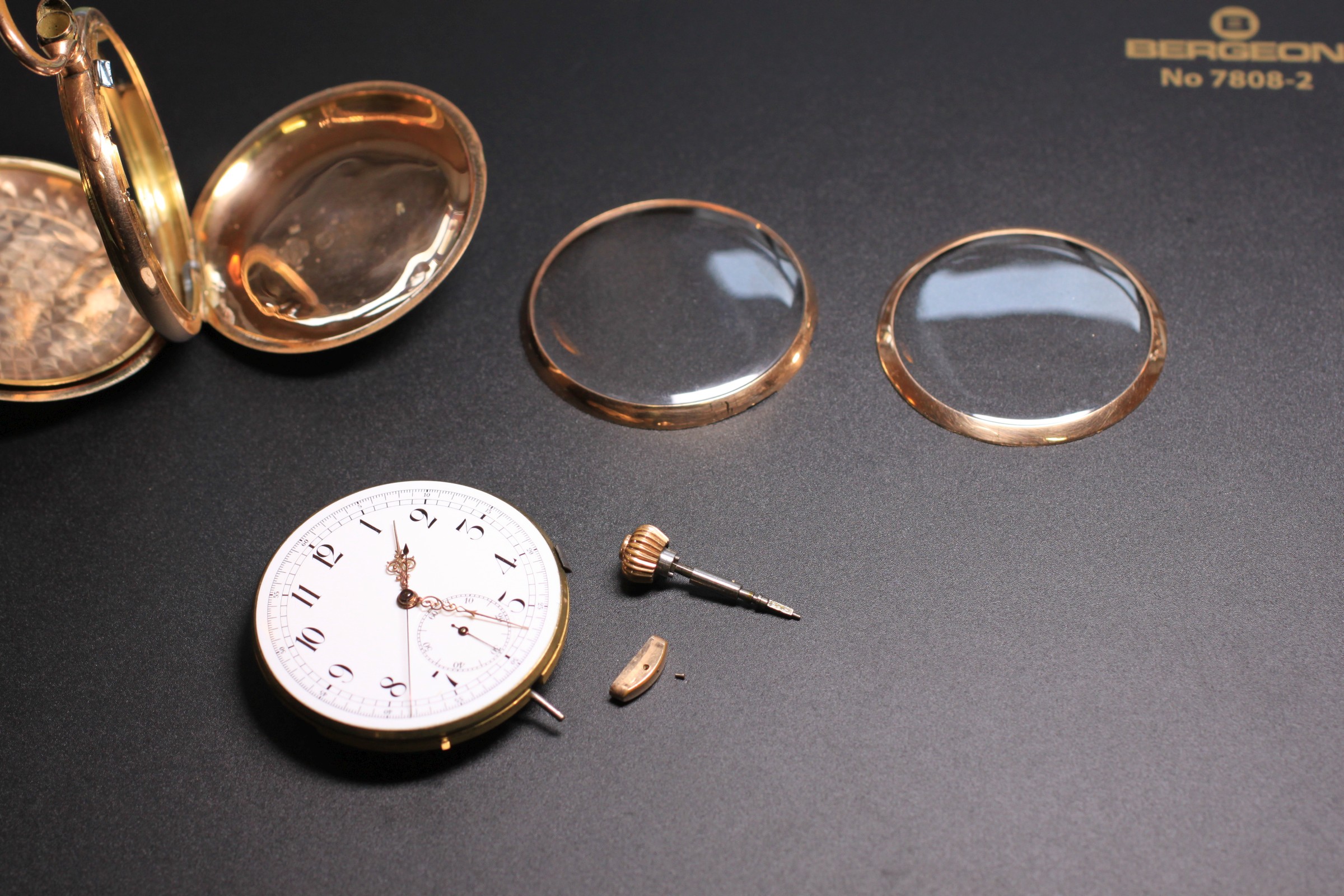
This pocket watch arrives in a sorry state. It has stopped, and the repeater strikes a random sequence irrespective of the time. There appears to be substantial damage in the gear train, and the repeater is at least out of adjustment, but more on that later.
In addition to the repeating mechanism, the pocket watch has a chronograph function: a stopwatch mechanism.
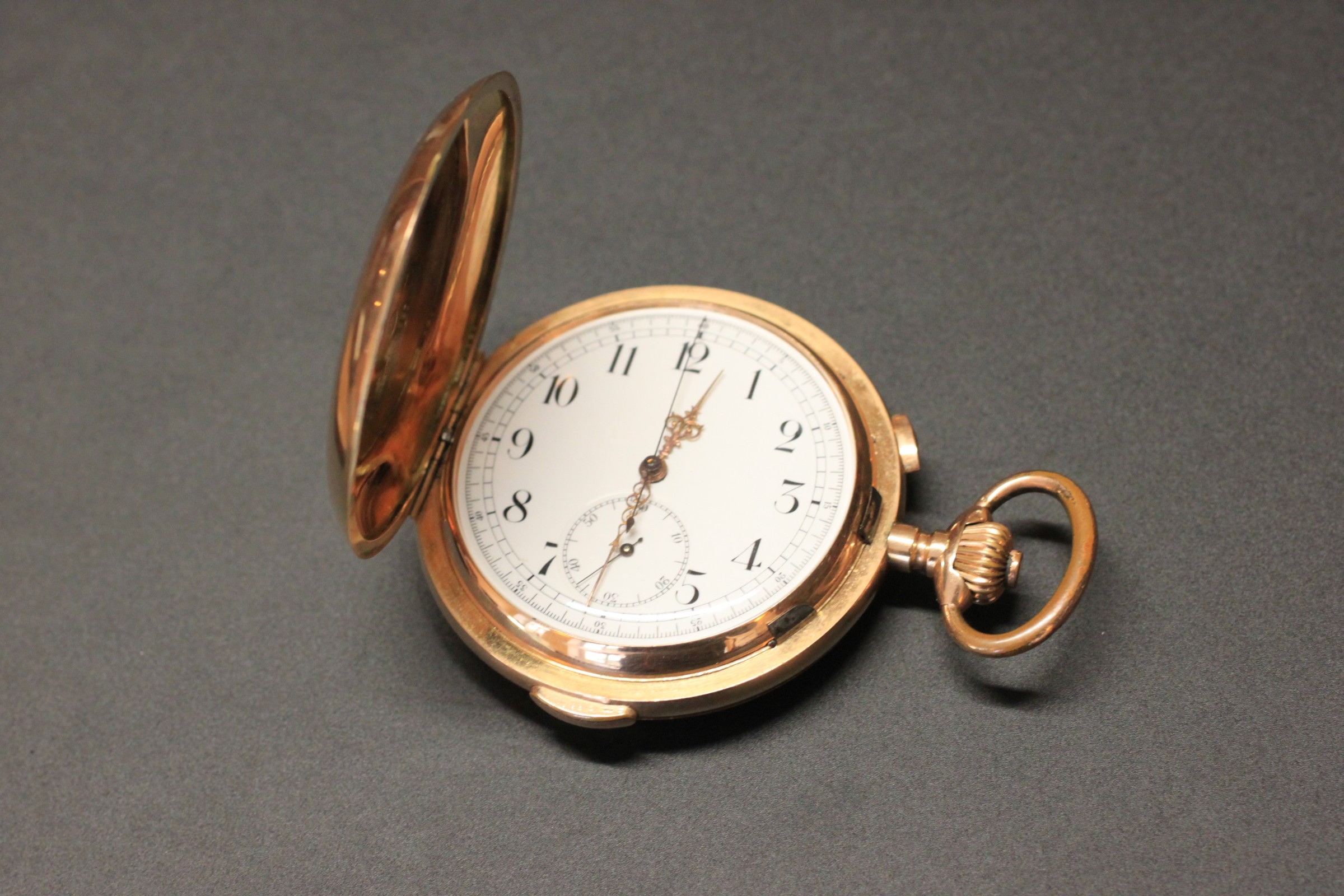
The lower button activates the minute repeater and must be pressed fully in for this.
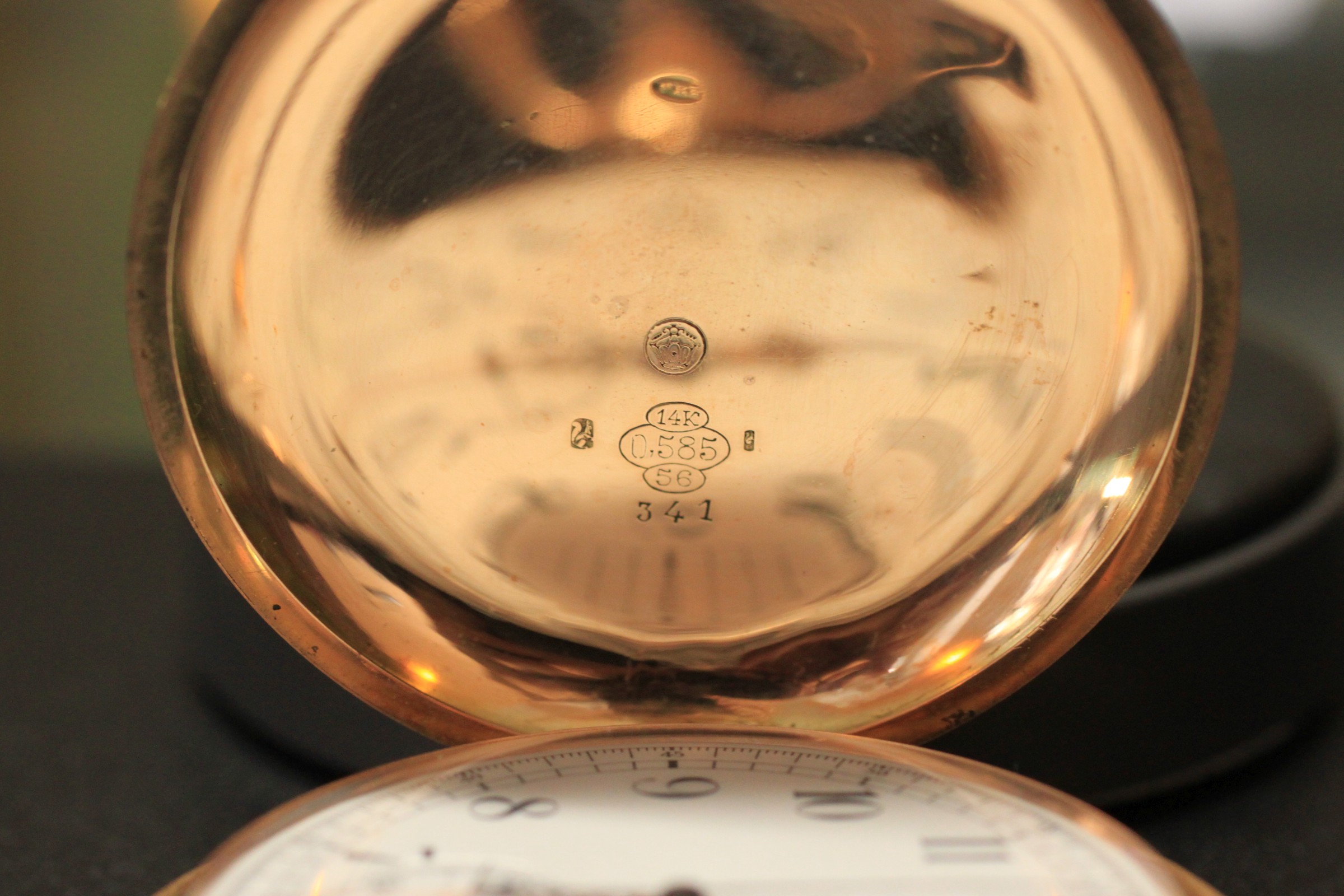
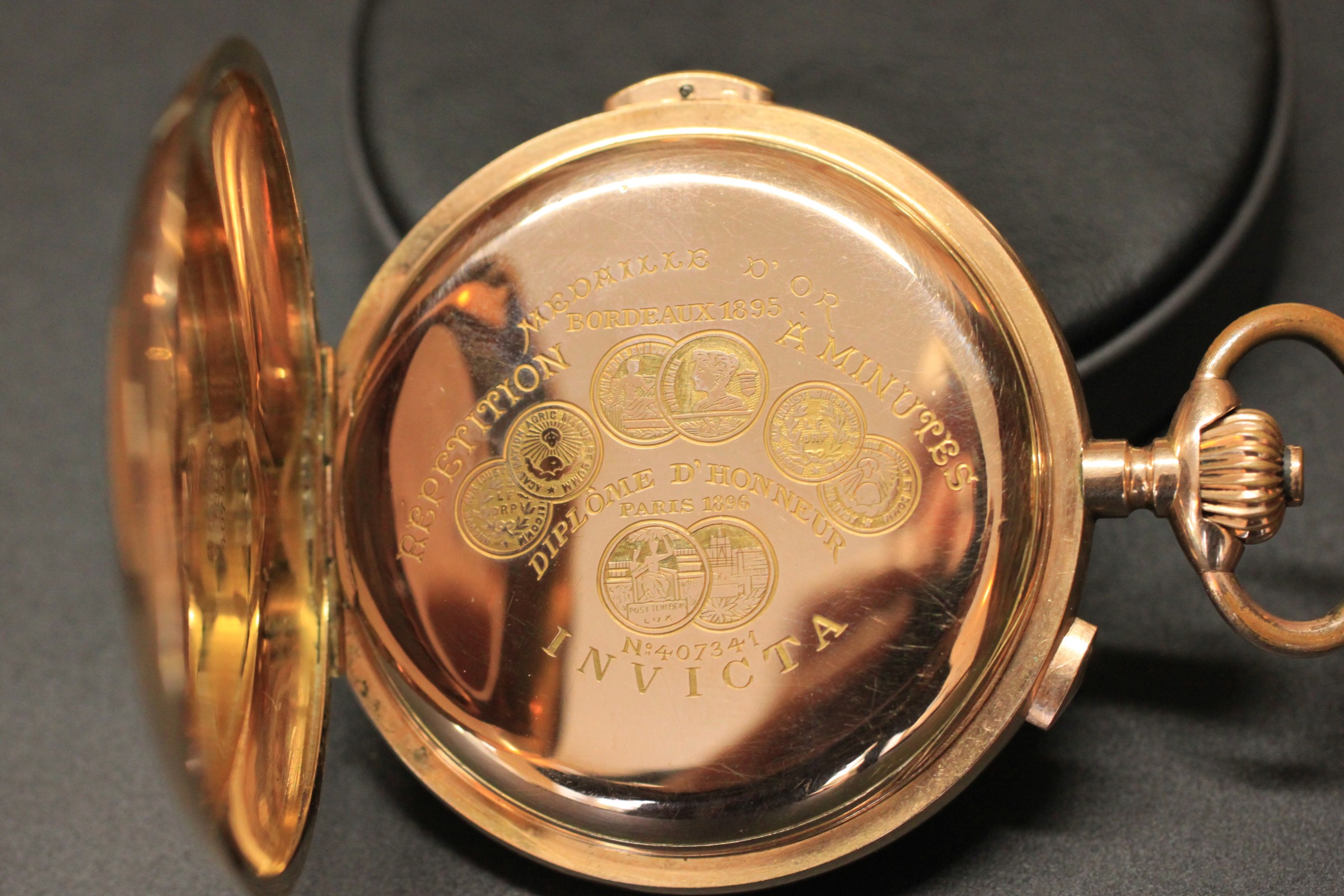
(Gold medal, Bordeaux 1895; minute repeater, honorary diploma, Paris 1896)
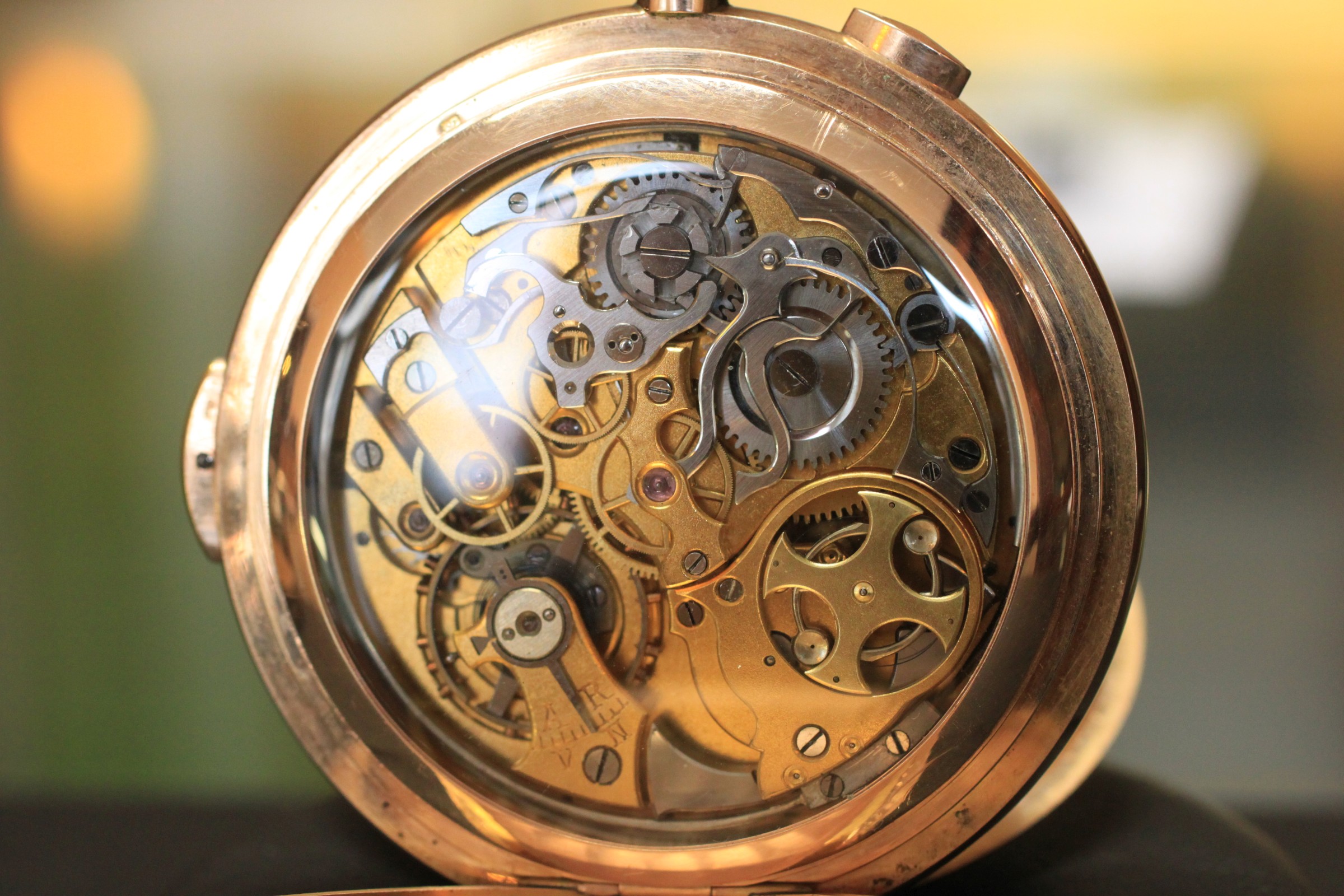
After checking the case functions, the case can be dismantled to remove the movement. No fault can be found with the crown or pushers, so the case is only cleaned.
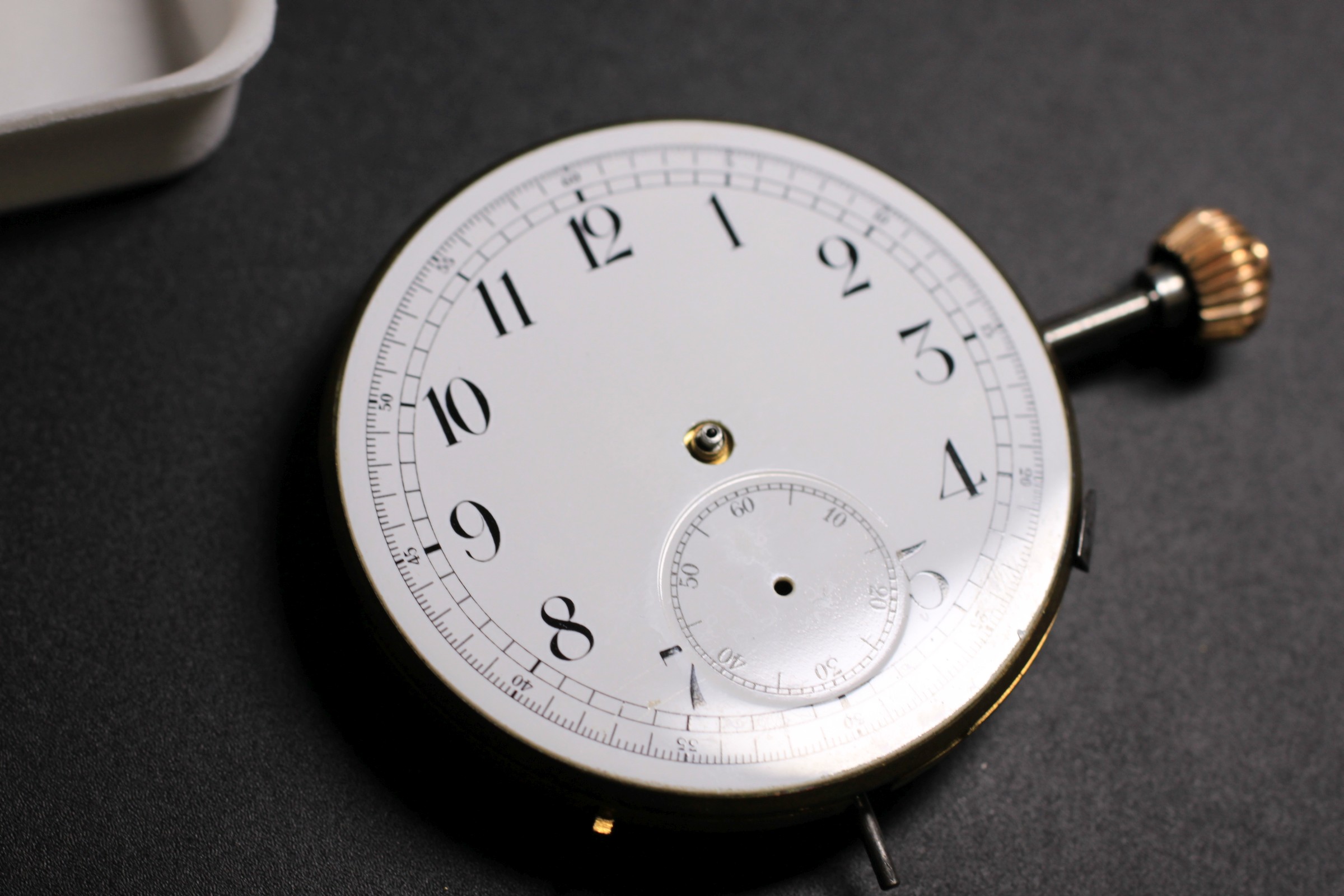
Beneath the dial, the repeating mechanism and hand-setting work become visible. Characteristic of a minute repeater is the “starfish” connected to the quarter tube, also called the minute snail, with four sets of 15 steps.
Every time the repeater pusher is pressed fully in, several levers (the hour, quarter and minute racks) descend and come to rest on their stepped snails (the hour, quarter and minute snails). The depth to which the levers can descend determines the distance through which they are subsequently raised again. This distance ultimately determines the number of strikes, since the teeth on the back operate the striking hammers during the return movement.
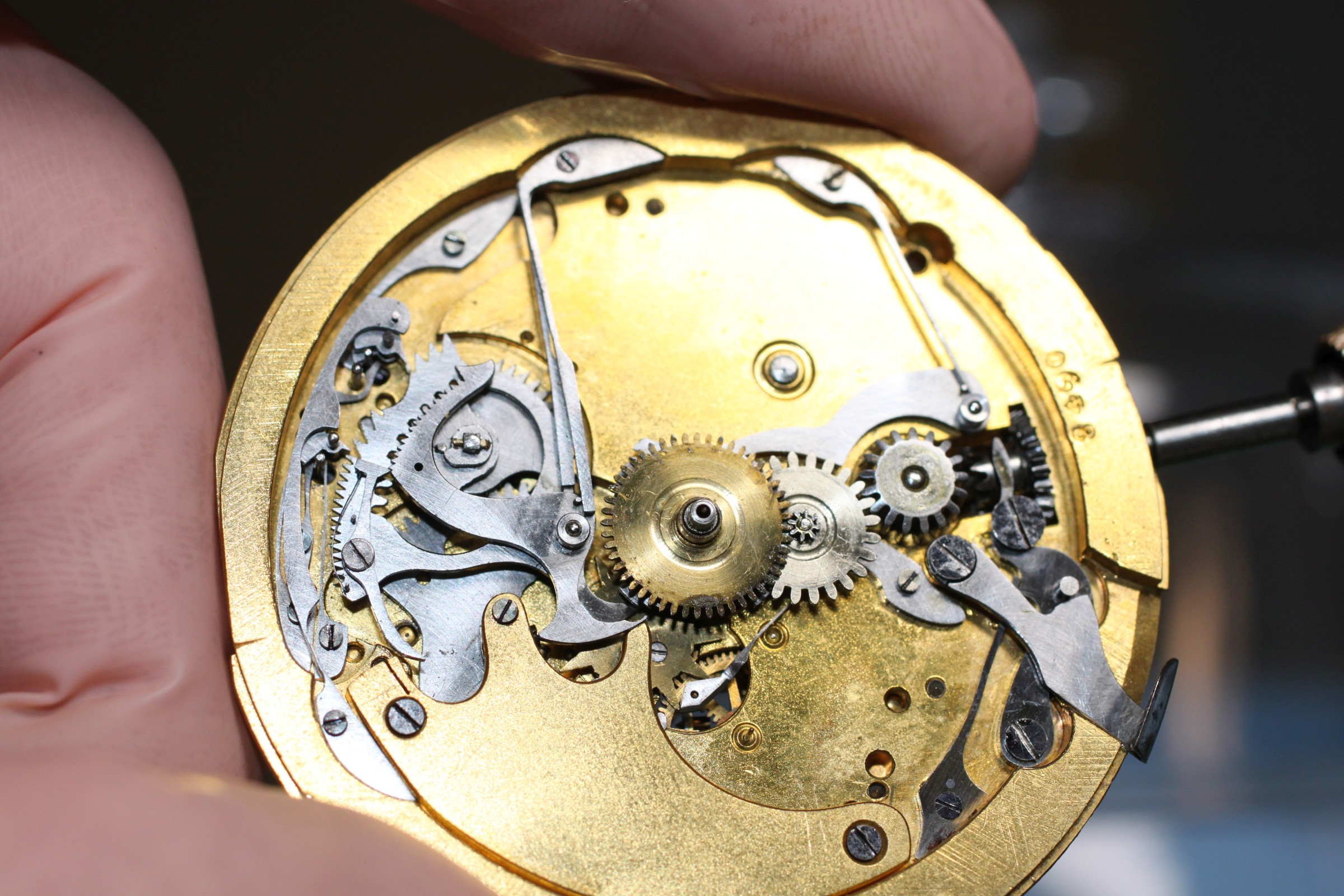
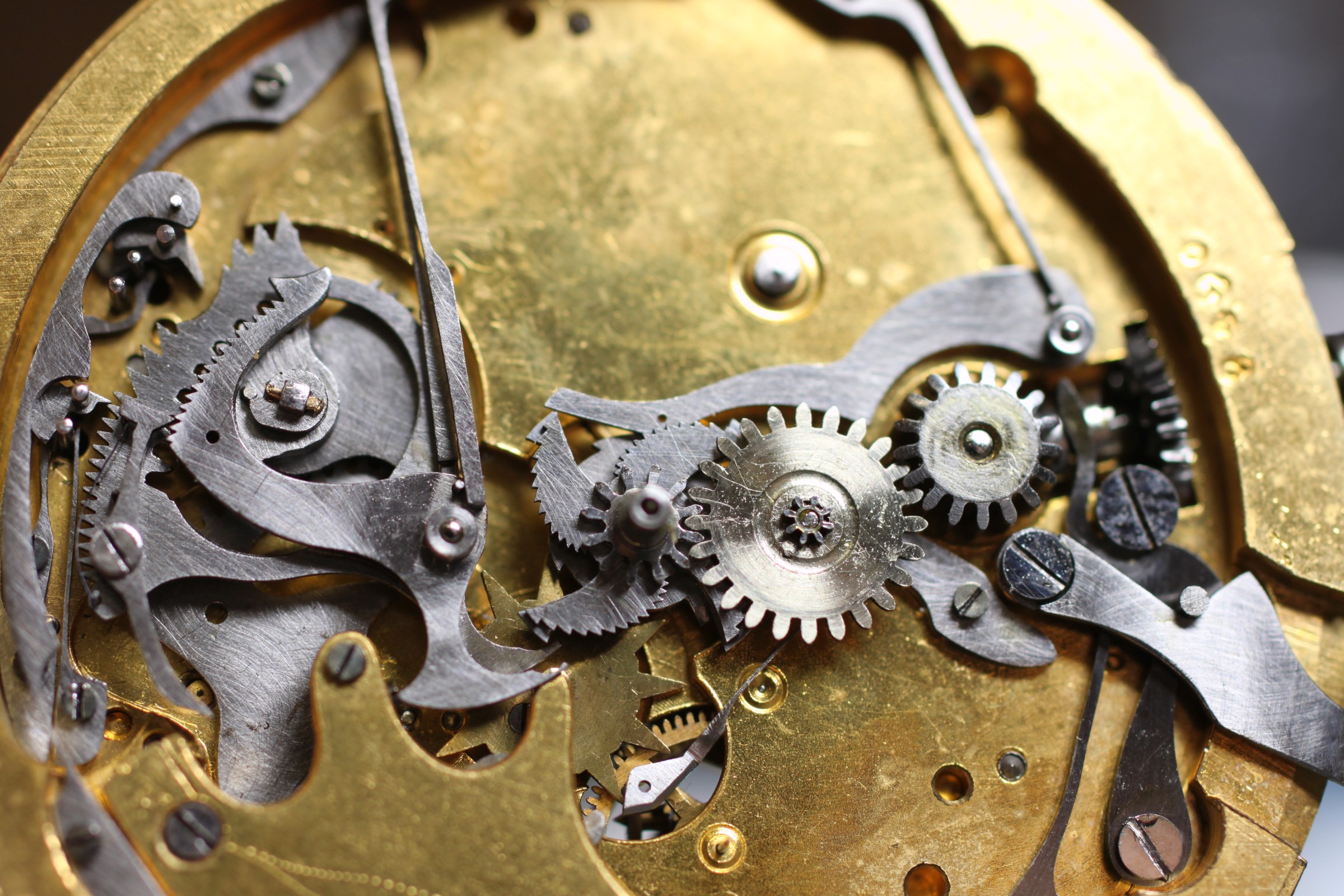
What is impressive about a minute repeater is that there is not just one lever sensing the minutes. There are three functions, for minutes, quarters and hours, which are synchronised with one another and then run consecutively rather than simultaneously.
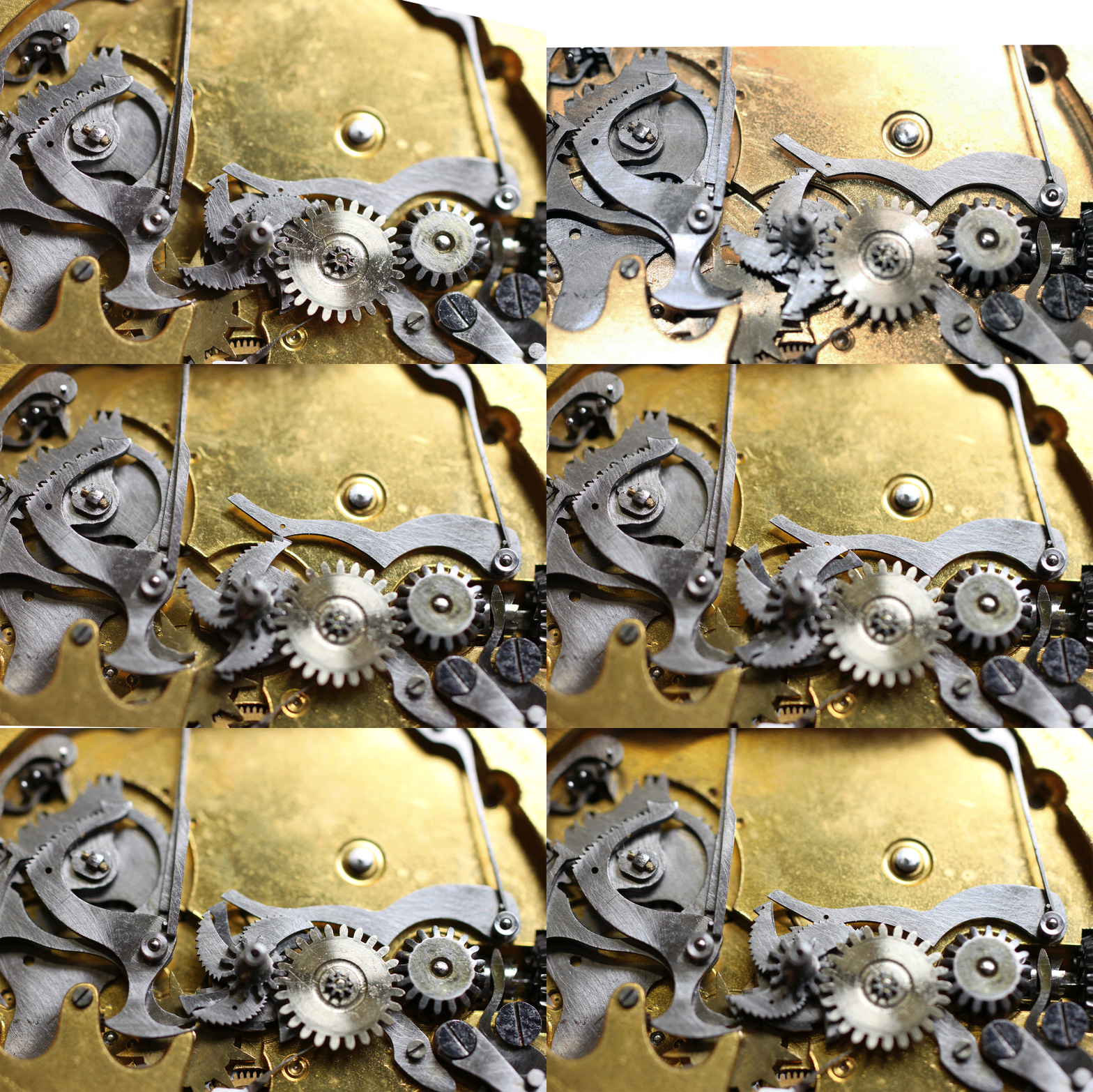
The lever at the upper right in the following photograph is another interesting technical solution. Building a minute repeater without this lever presents several problems. First, it is very difficult to maintain the timing so that, at an exact quarter-hour, 14 minutes cannot still be struck. Secondly, the whole mechanism can jam:
The problem between 14 and 0 minutes
- The minute snail rotates clockwise
- Activate the repeater when the minute feeler is above the deepest step (the 14-minute step)
- The lever/feeler has descended to the deepest step. While the lever slowly rises again and the minutes sound, the quarter snail (“starfish”) continues to rotate
- The lever/feeler has not yet fully risen and all the minutes have not yet sounded when the minute snail reaches the lever
- The flank of the highest, outermost step (the 0-minute step) presses firmly against the minute feeler. It can no longer rise, and the watch stops
An elegant solution was found. The outermost step of the minute snail is made to fold away: it is called the surprise piece. The very broad outermost step is thus completely out of the way while the feeler reads 14 minutes. Timing can also be set very precisely, as the seconds hand can be positioned at zero immediately after the surprise piece is released, giving very accurate activation of the striking mechanism. Thirdly, the force of the surprise-piece spring is insufficient to stop the minute feeler. Should a collision occur, the feeler simply continues to rise, unaffected by the gentle pressure of the surprise piece.
The quarter rack
The following photograph shows the minute feeler, which looks almost like a seahorse. Its „eye“ is the pivot axis of the minute feeler and of the combined minute and quarter rack.
- beneath it. When the repeater is activated, this combined rack turns anticlockwise until its sensing tip, the quarter feeler, comes to rest on the quarter snail (located beneath the “starfish” and having four steps).
- This presses the back of the pawl engaging with the minute feeler’s ratchet teeth against the gilded bridge above the slot, releasing the minute feeler.
- The spring-loaded minute feeler rotates sharply anticlockwise until its sensing nose rests on a step of the minute snail.
- The spring force of the repeating mechanism then slowly raises the rack, whose teeth count out the quarters first, followed by the minutes.
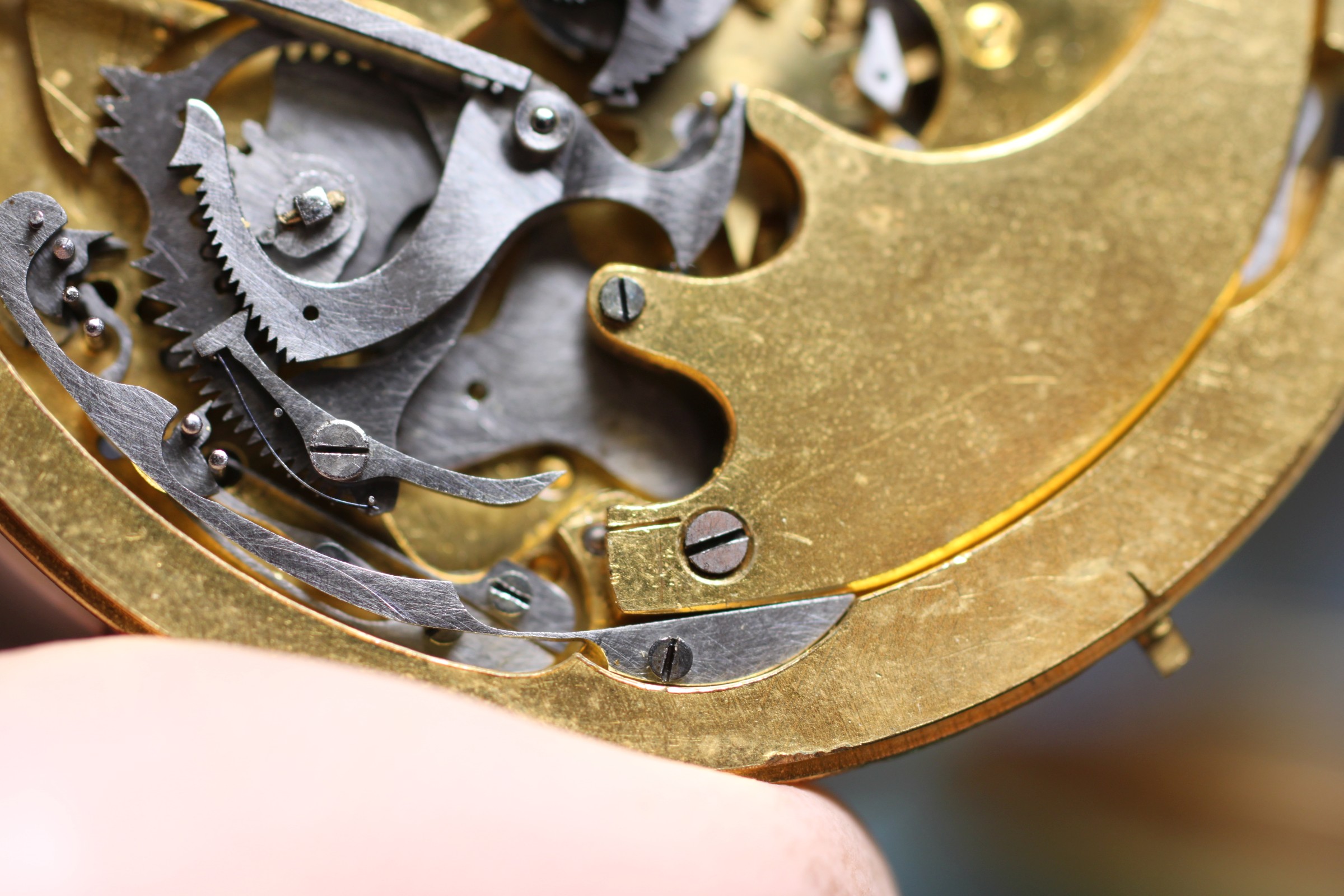
It is rather unusual for the quarter feeler and quarter rack to be on two different components. Normally, the quarter rack and its feeler form one part, and the minute rack and its feeler form another. This may be why the striking mechanism did not function at all in this case. The person adjusting it saw a classical minute repeater and did not understand the function of the pawl in this unusual case. Normally, the pawl would engage with the combined minute rack and feeler after the quarter strikes have sounded and then drive it.
Here, however, the repeater works differently. The „chin“ of the seahorse defines the maximum movement of the combined minute and quarter rack. The two components are connected by the pawl and sit one above the other on a single axis. Here, it is essential that the pawl does not simply engage with the teeth: it must engage with exactly the right tooth.
The visible slot in the gilded bridge allows the correct pawl timing to be set by bending the bridge slightly outwards.
With its previous adjustment, the striking mechanism sounded chaotically. Since the bridge looks completely untouched and was never adjusted at the slot, the repeater was probably never set correctly after manufacture. It took 120 years after its manufacture in 1895 for the watch to arrive on my workbench and for the movement to chime the time correctly for the first time. How this happened is a mystery to me. The pocket watch must have been completed in haste, otherwise this would hardly have occurred. There is surely an interesting story here, but it will probably never come to light.
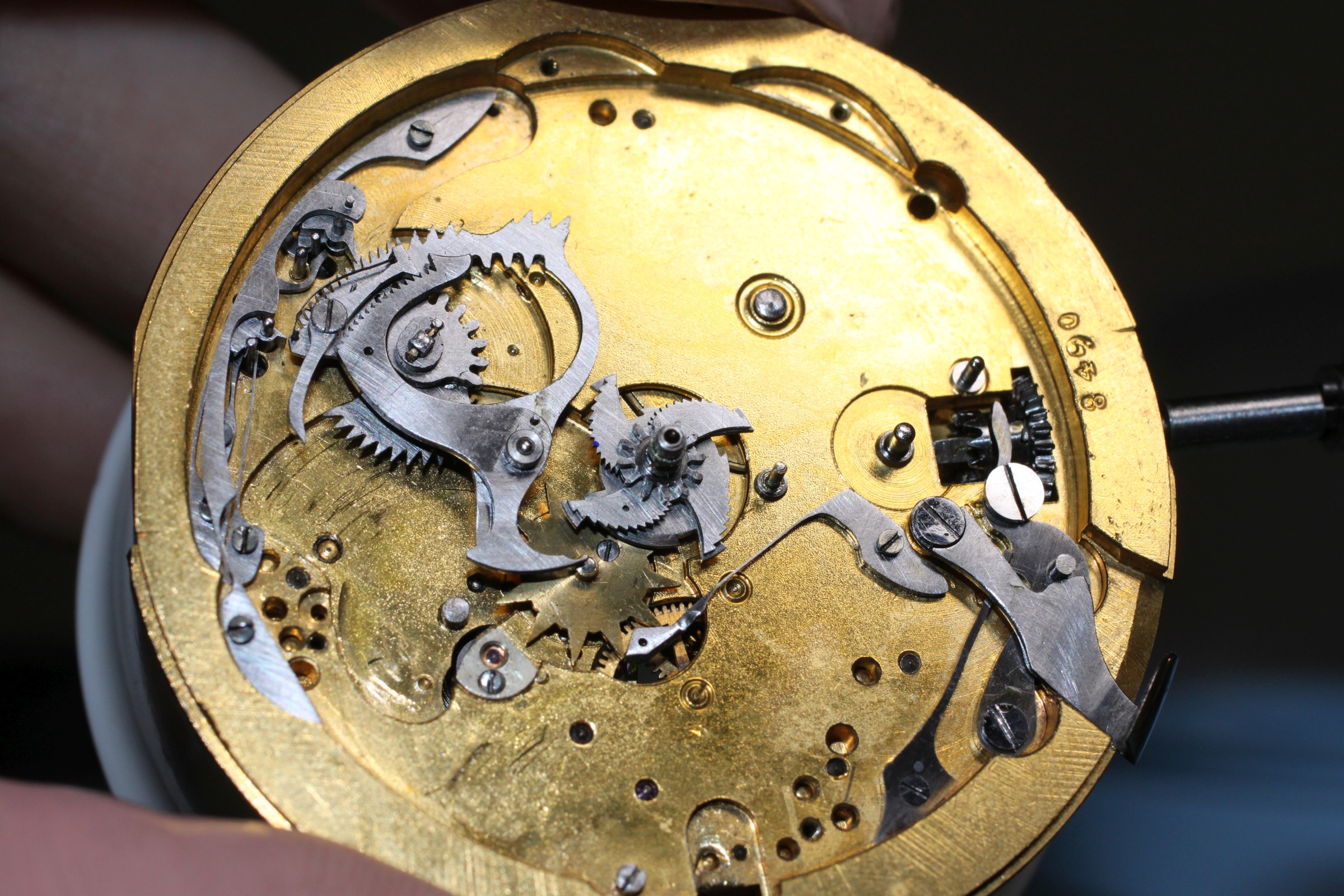
Incidentally, the hours are counted by another snail with 12 steps, hidden beneath the minute snail (“starfish”) in the photograph above. An hour feeler, already removed here, descends onto this snail. The hour feeler also limits the repeater’s release lever, which is operated directly by the slide outside the case. The 12-point star beneath the minute snail is advanced once an hour by a pin in the quarter snail.
(The quarter snail sits on the same arbor as the minute snail, one level below. It contains a small pin that advances the 12-point star once every hour.)
In the following photograph, the hour rackis visible out of focus. It is the first to strike after the repeater is activated. The long component at the top is the release rocker. Beneath it, to the left and right, are the hammer lifting levers („bird’s head“) for the small hammer on the left and the large hammer on the right.
When the snail operates the two hammer lifting levers with its teeth, the hammer on the other side of the movement is lifted and released, causing it to strike the gong .
There are several springs on the hammer lifting levers. Their function is straightforward: the springs on top are striking springs, ensuring that the hammer strikes the gong once, cleanly. From the back, these springs can be adjusted very finely using the conical tip of a screw.
The two springs underneath are return springs, which are tensioned when the hammer is operated.
As not all the repeater’s racks fit into a single plane but lie one above the other, there are two hammer lifting levers one above the other, both working in the same way.
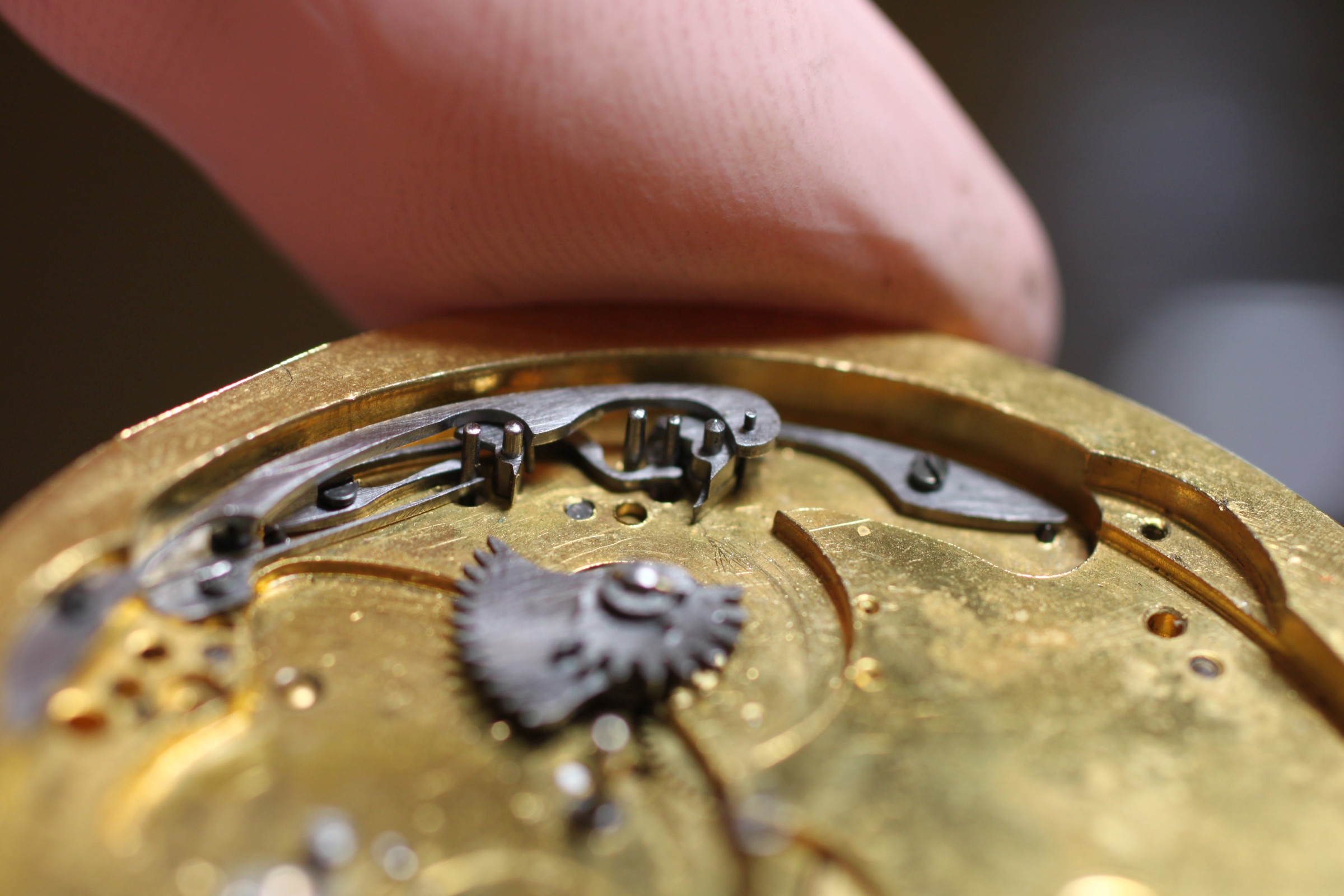
The centrifugal clutch is shown in the photograph below, firmly integrated into the repeater’s gearing. It ensures that the repeater’s mainspring runs down slowly. Without the centrifugal clutch, the repeater would run far too quickly and the strikes would be too fast to count. With the clutch, the striking mechanism runs at a leisurely pace and can easily be counted.
Other mechanisms can also be used to slow the repeater’s gear train. Modern alarm clocks often use a system with an escape wheel and an anchor that slides over the teeth and carries a weight. Some repeating watches also use this system.
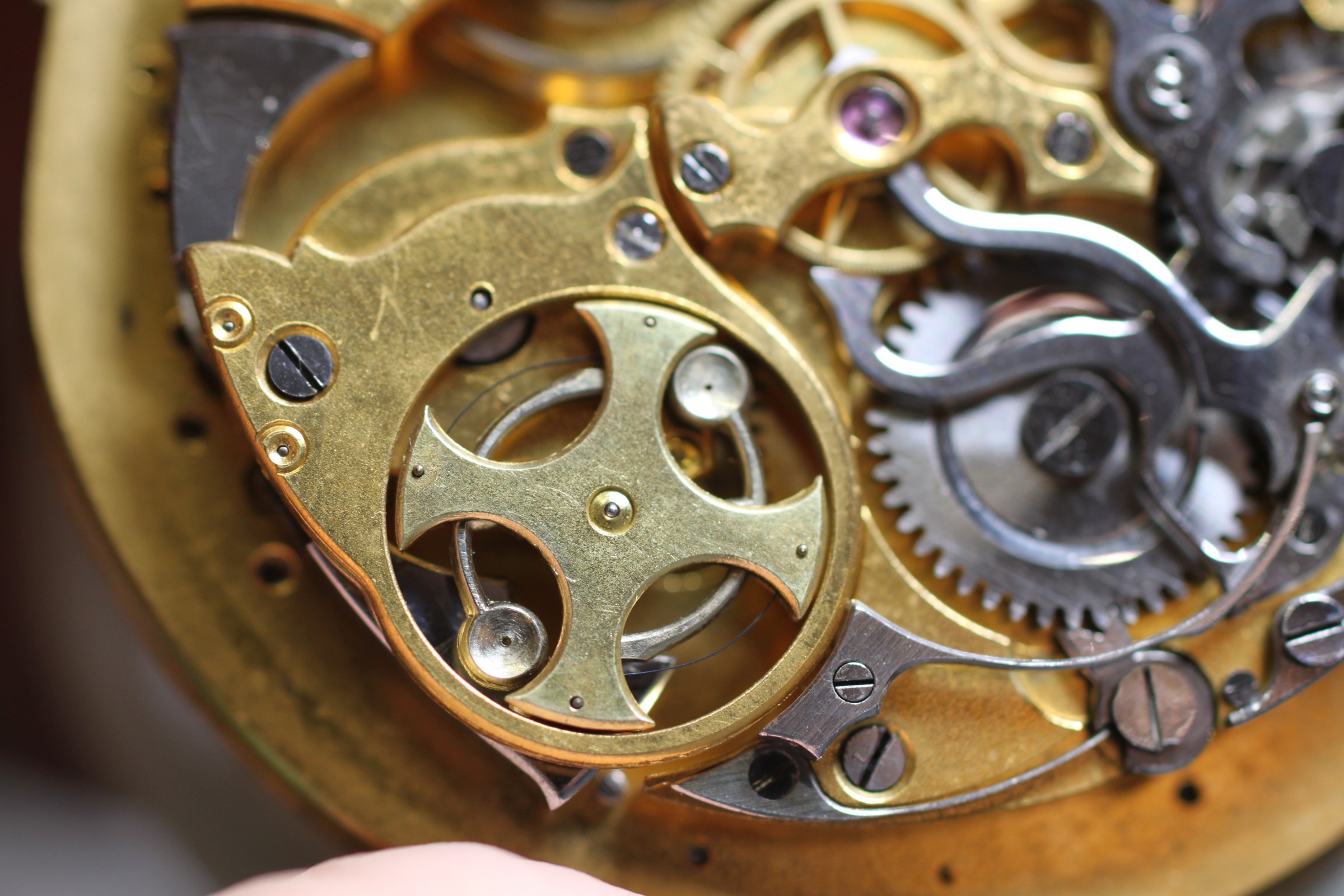
In most pocket watches with striking mechanisms, the bridge for the mainspring, together with its ratchet work and centrifugal clutch, can be unscrewed as a complete unit. There is no separate barrel for the striking mechanism, only a round milled recess in this bridge. The mainspring is tensioned each time the repeater is activated by turning the barrel arbor – , which slowly turns back as the spring runs down..
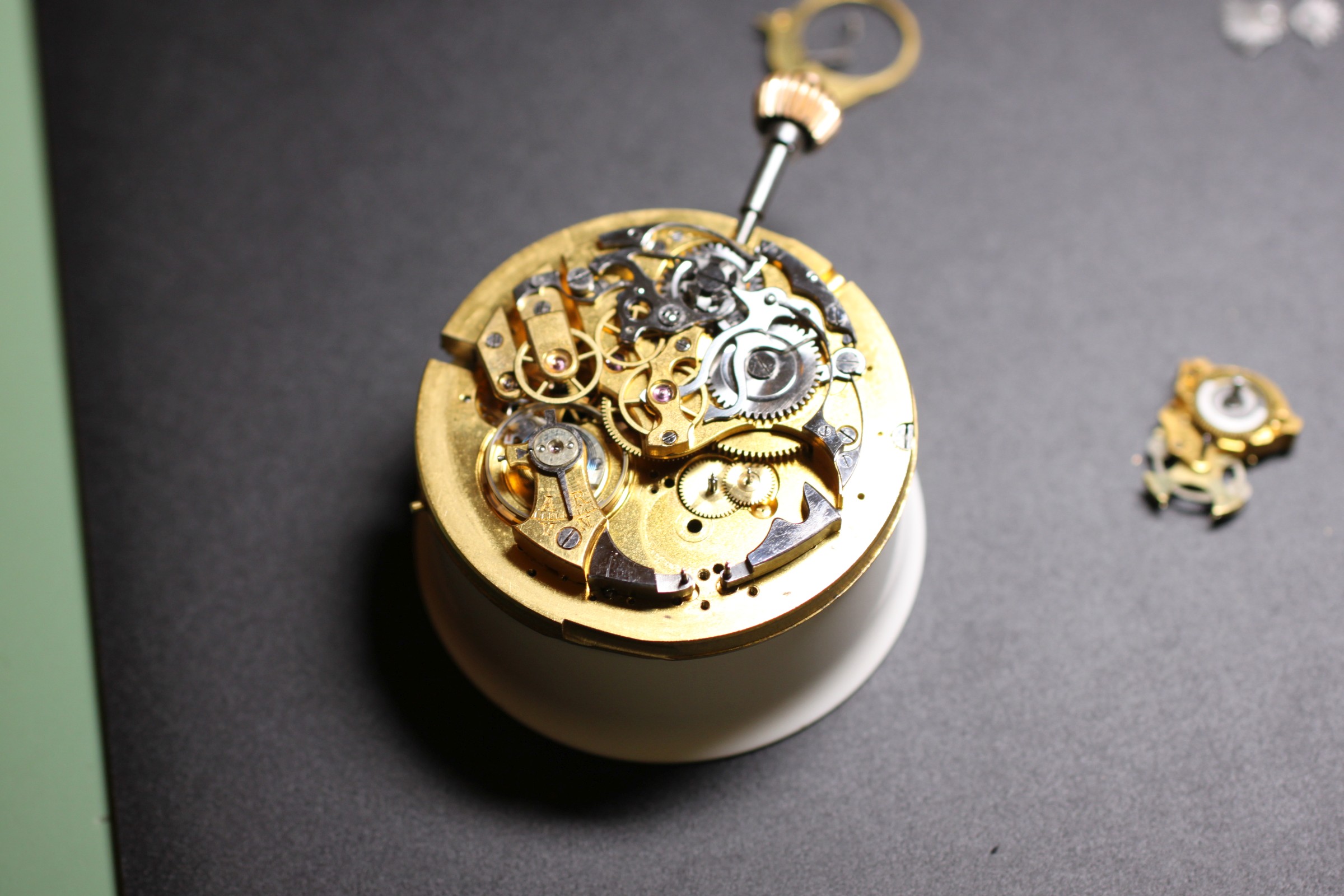
The next photograph shows the barrel arbor, beneath which the coiled mainspring sits in the bridge. The visible ratchet work has only one purpose: when the spring is wound by activating the striking mechanism, the ratchet slips – and nothing happens. When the spring force turns the barrel arbor back in the opposite direction, however, the ratchet drives the large wheel shown. Through two further wheels, not visible here, this drives the governor, slowing the running-down movement as described above.
On the other side of the barrel arbor, on a square, the previously mentioned hour rack is fitted, together with the pinion for the quarter rack and further components.
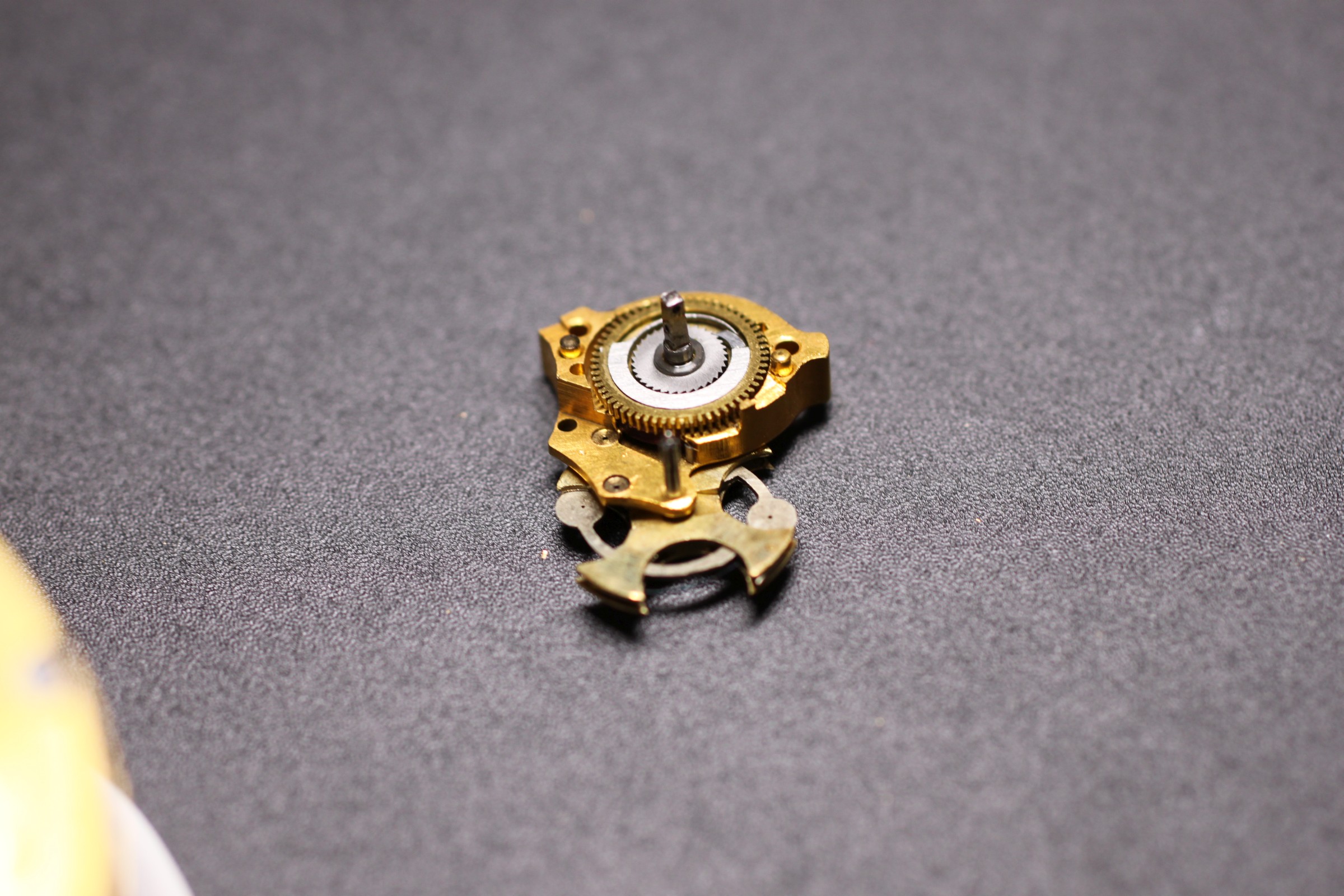
After removing all repeater parts on the movement side, the going train for time display and the chronograph mechanism remain.
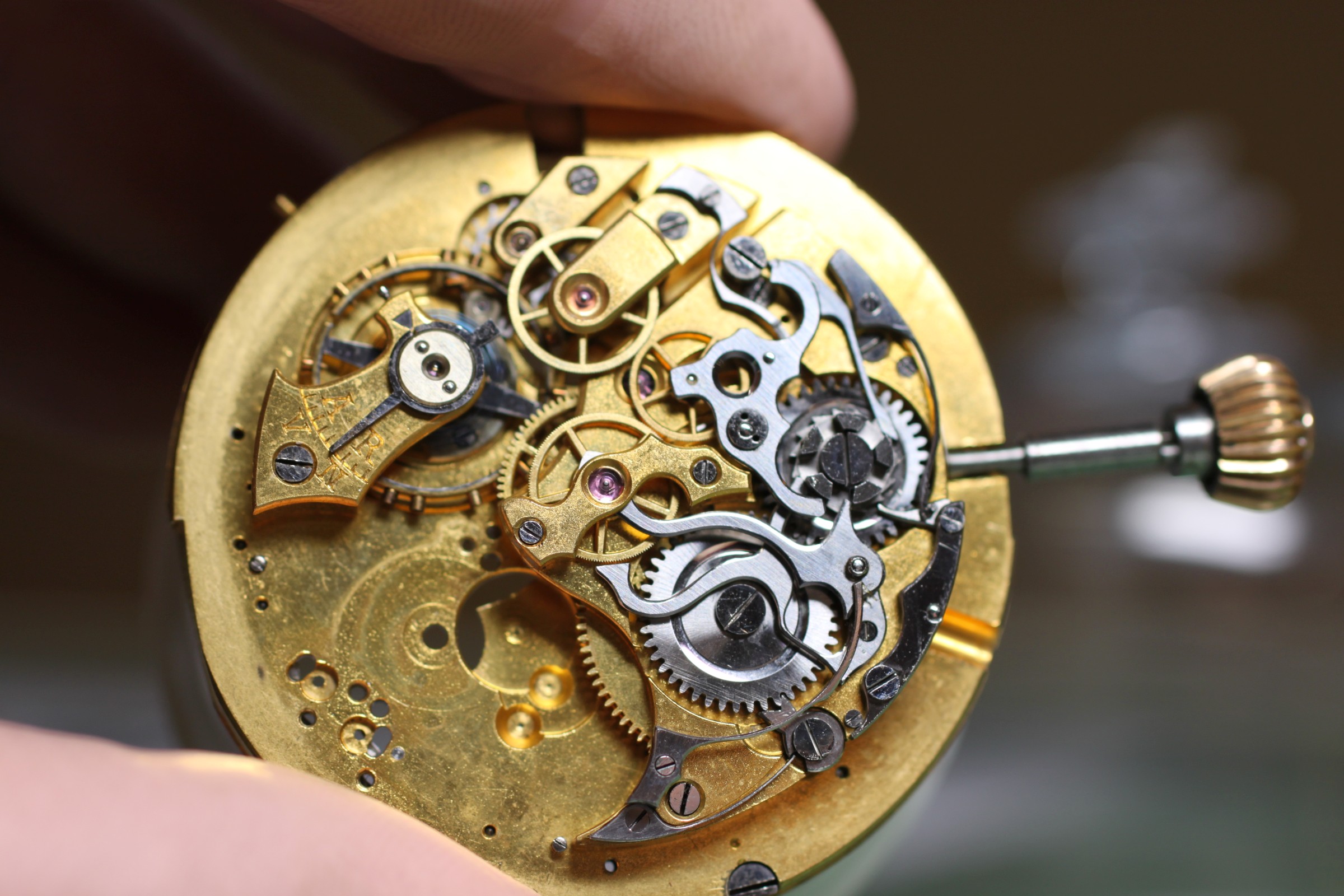
The watch has run for many years, unfortunately also for many years dry and dirty. As a result, even the upper ruby cap jewel of the balance is worn. A small, point-like mark is visible at its centre.
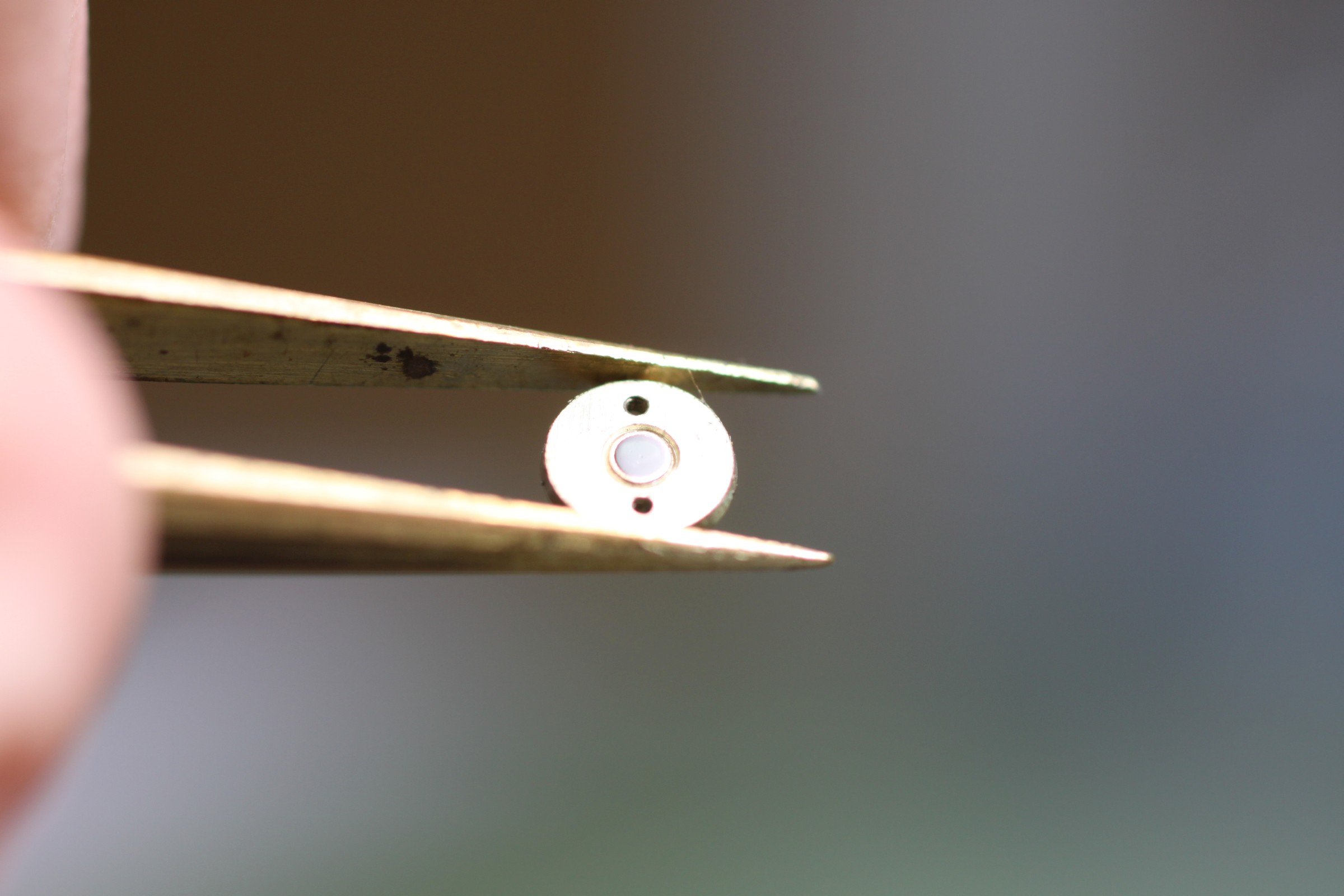
The cap jewel was therefore removed from its setting by tapping it out with a flat piece of pegwood and a hammer…
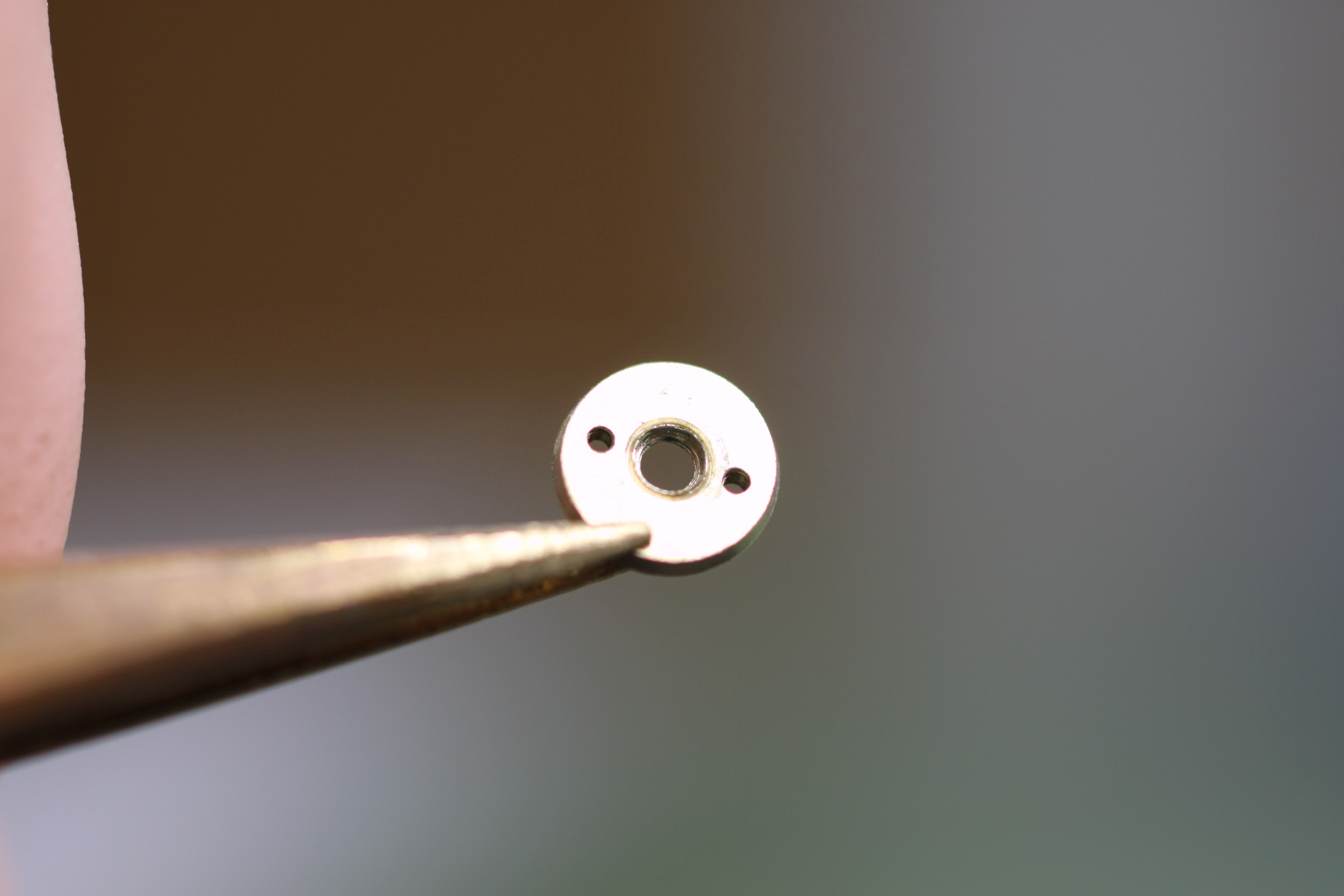
…, then reground and polished using hollow pegwood.
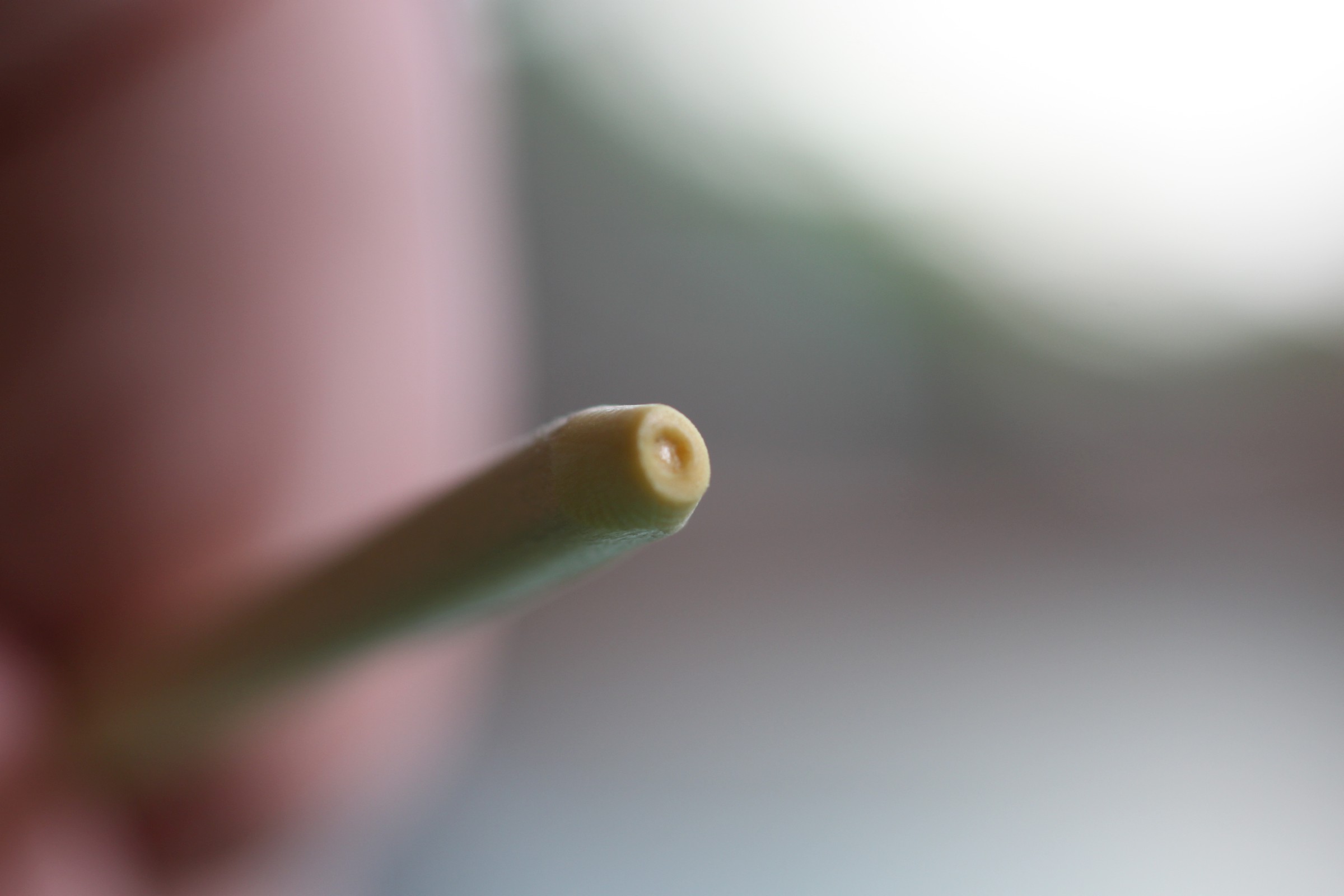
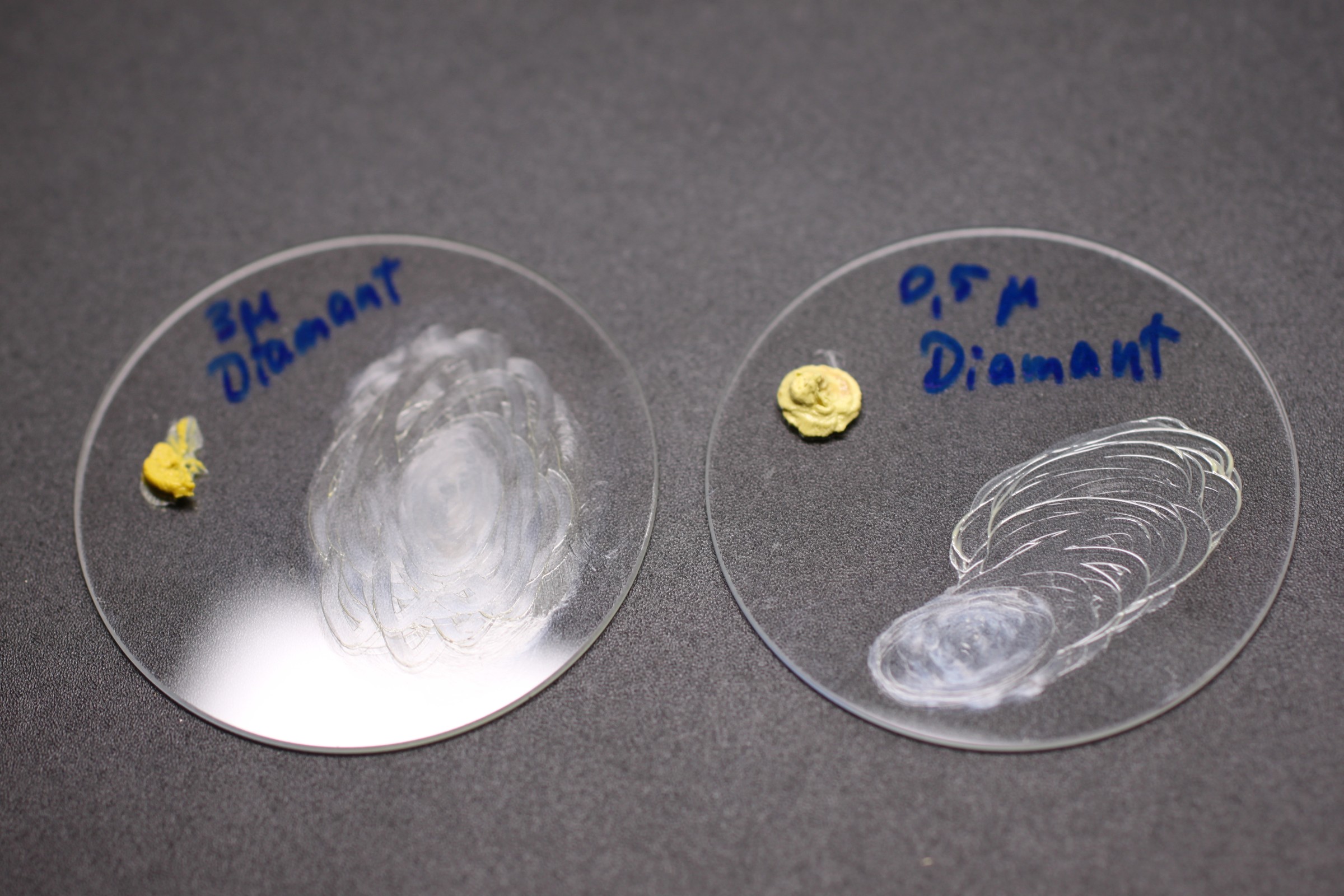
With today’s diamond abrasive pastes in various grain sizes, this is comparatively straightforward. In earlier times, diamond powder came only from natural diamonds and was much more expensive, so classical watchmaking offers no assistance here. The greatest difficulty is developing a feel for the pressure and time used when grinding and polishing. A little too much pressure causes the diamond particles to catch in the glass plate or roll, producing scratches.
This photograph was taken earlier. Today, I prefer working on a tin or brass disc, into which the diamond particles can press slightly, making it somewhat easier to polish very small parts.
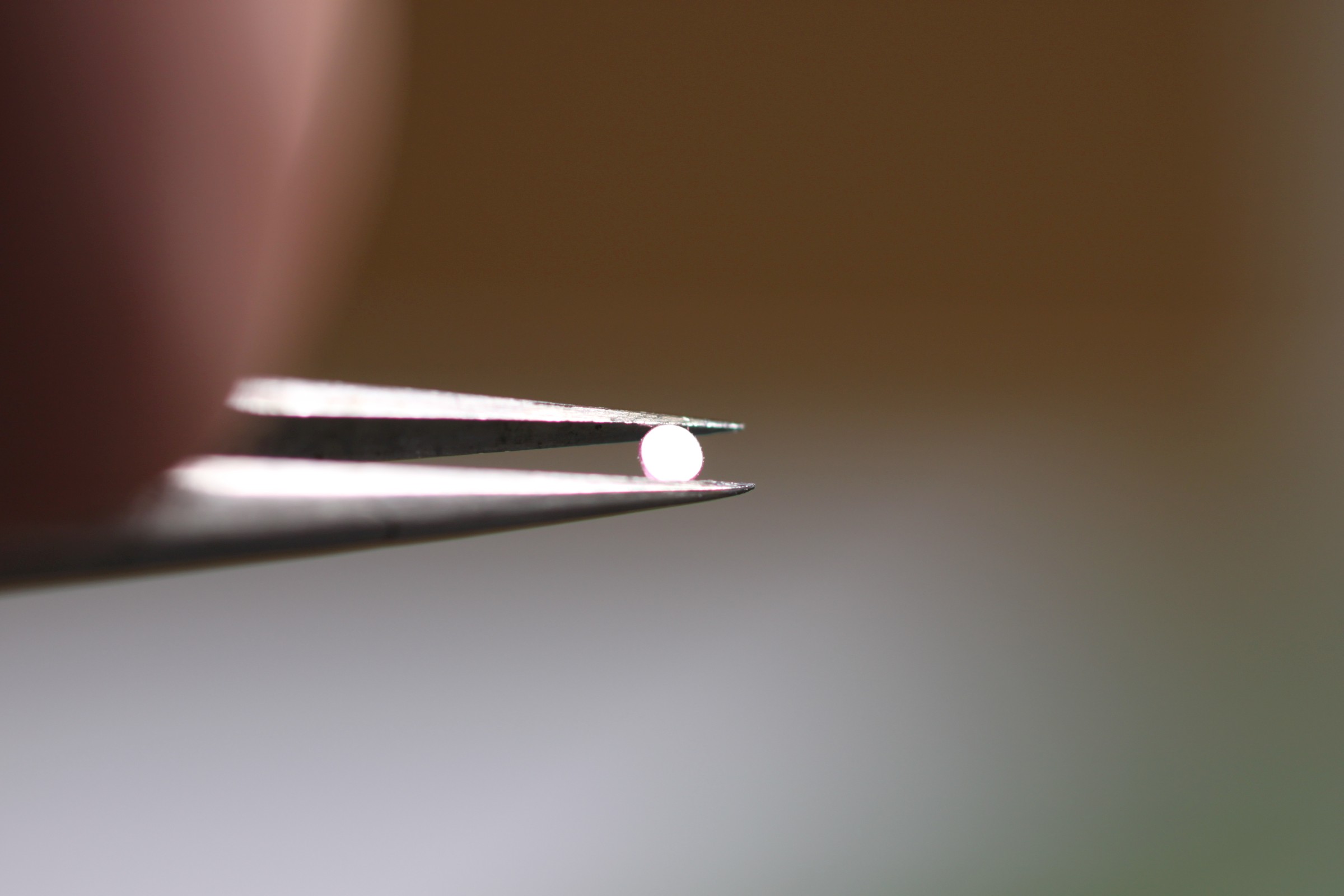
Nevertheless, a result flawless under a loupe can also be achieved on a glass plate. In the final step, the polish is given a very brief finish with felt and a Dremel to achieve an immaculate mirror finish.
Note: Depending on the ruby’s quality, inclusions may be encountered when regrinding, leaving an unattractive surface. Very poor rubies with many inclusions are effectively very difficult to regrind, and a perfect surface cannot be achieved. In this case, it is better to replace the jewel. Old assortments of natural ruby watch jewels are still available at watch-parts fairs.
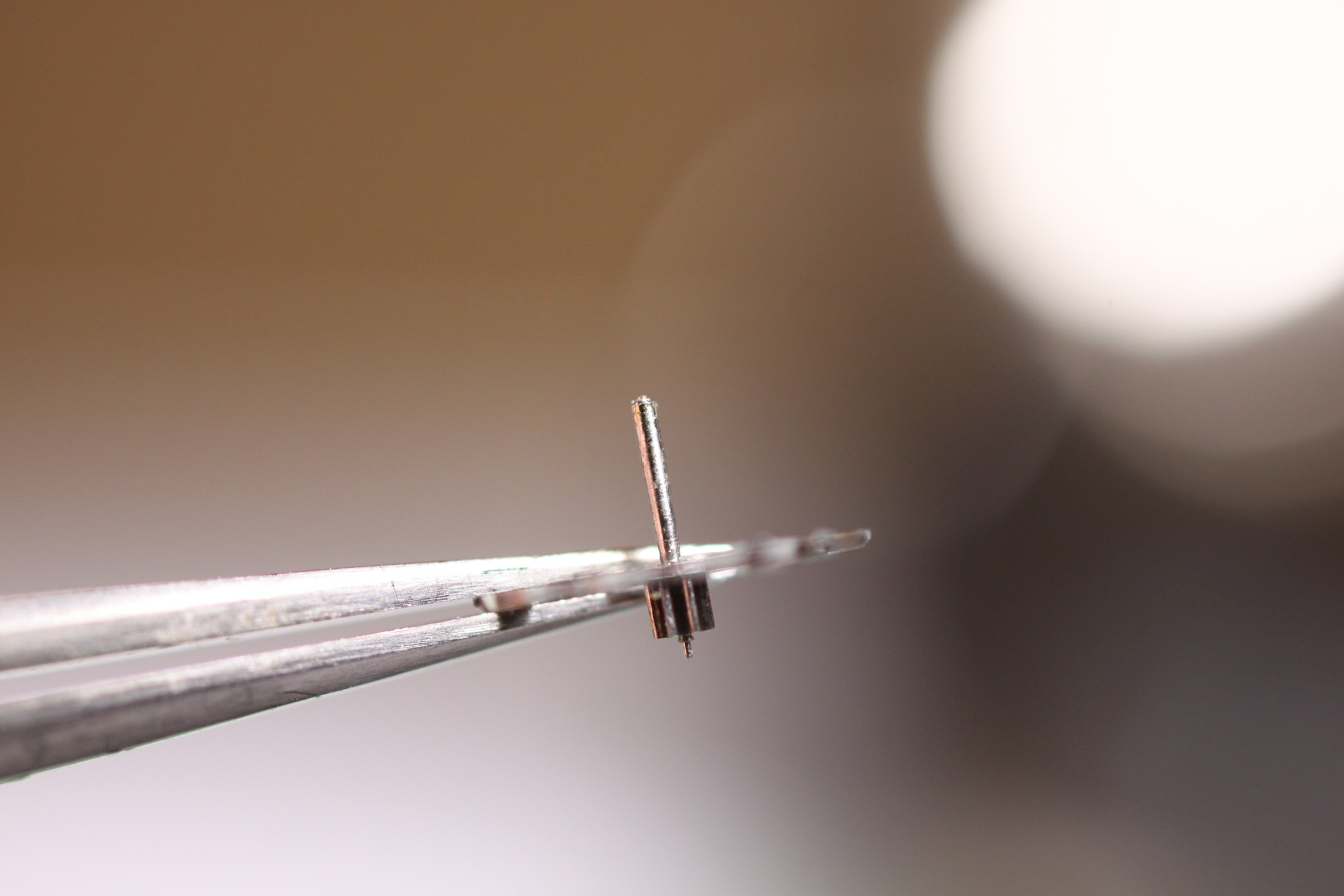
As disassembly continues, serious damage is revealed: the upper pivot of the escape wheel has broken off completely. Several repair methods are possible here:
- Drill in a pivot – : first drill a hole in the arbor, press in a new pivot, then burnish it back to the desired dimensions
- Shorten the arbor slightly and turn a shoulder, then press on a new piece of arbor and turn a new pivot
- Build up material by welding, then grind it round and burnish the new pivot (I could not yet do this when this repair took place, but it is now a viable option)
- Make an entirely new arbor
Since I had a very good arbor blank with pinion available in this case, I made a completely new arbor and refitted the escape wheel.
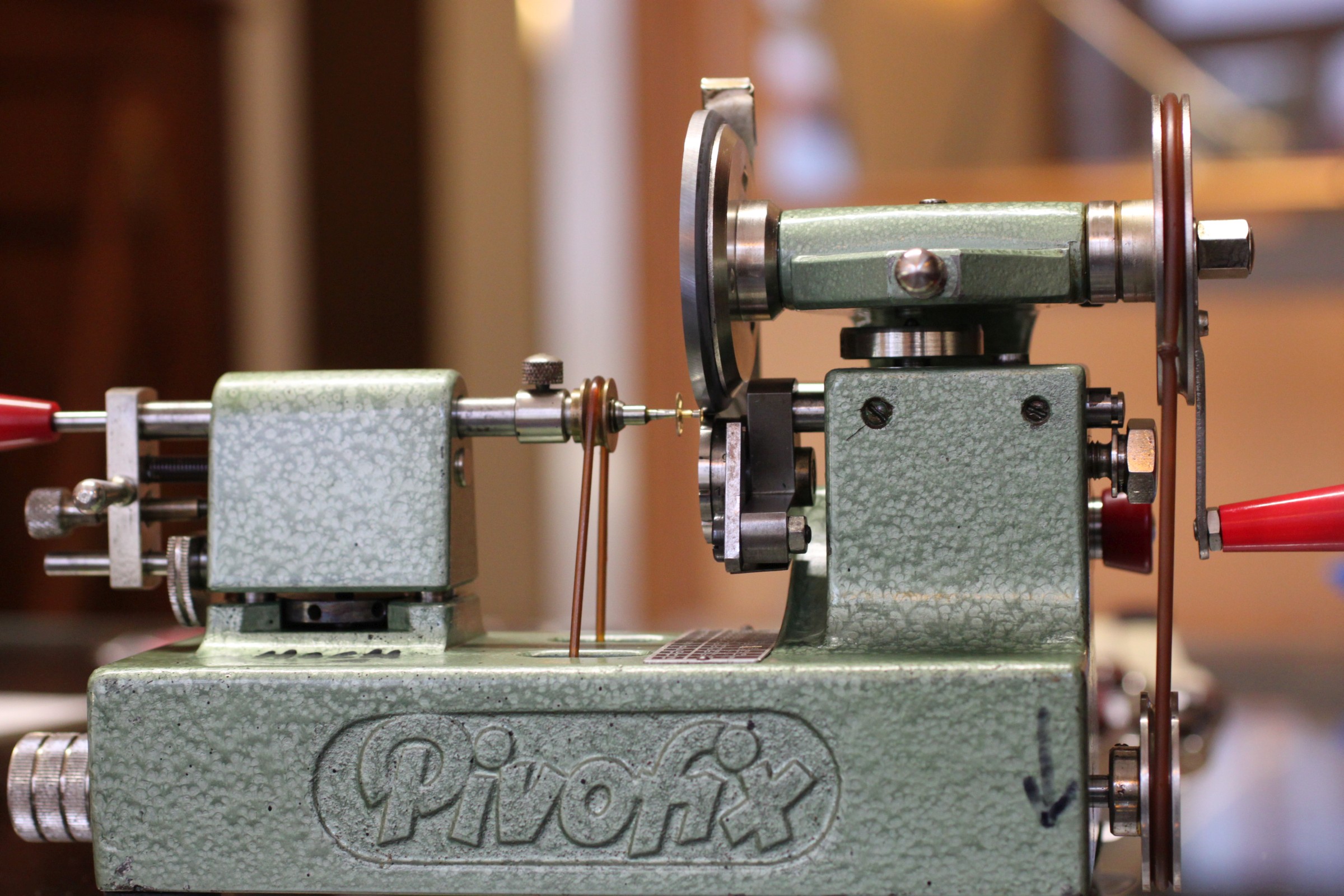
Further pivots in the gear train are worn. These can be returned to perfect condition with the Pivofix, a pivot burnishing machine for watches. Above is a carbide disc with a fine transverse finish; below is a runner with milled slots into which the pivot, the bearing portion of the arbor that runs in the ruby hole jewel, is placed.
After setting the machine to the correct height and diameter, the red crank on the right is turned. This rotates both the carbide disc and the wheel, which is turned by the driver.
The Rollimat is very aggressive, and experience is needed to avoid removing too much material. With a pivot diameter of 0.15 to 0.25 mm, removing just a few hundredths of a millimetre can quickly scrap it, requiring a new pivot.
For practice, it is better to start with any wheel from the spare-parts box. This also makes it easy to set the Rollimat to a desired diameter.
Incidentally, a watchmaker’s hand-operated Jacot tool with bow drive is equivalent. With a little practice, it can even be considerably faster and safer to handle, achieving results just as perfect as the Pivofix.
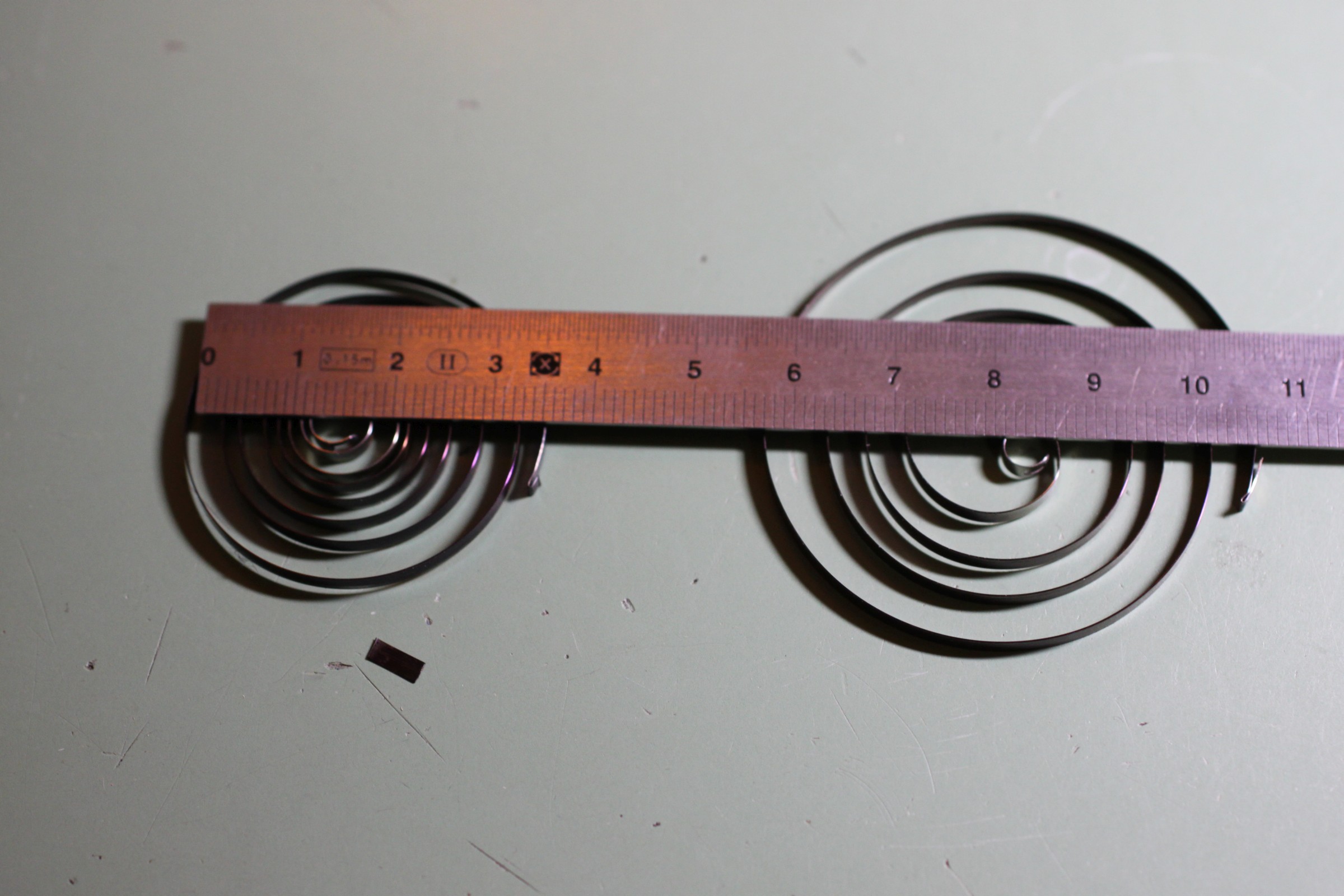
Here you can see why it often makes sense to replace the mainspring during servicing. The spring on the left has the same dimensions as the new one on the right, but is fatigued and therefore has a smaller diameter when removed. As a rule of thumb, its diameter should be at least three times the barrel diameter.
Fatigued springs also regularly tend to break. This would be very frustrating shortly after a service, since almost the whole movement must be disassembled again.
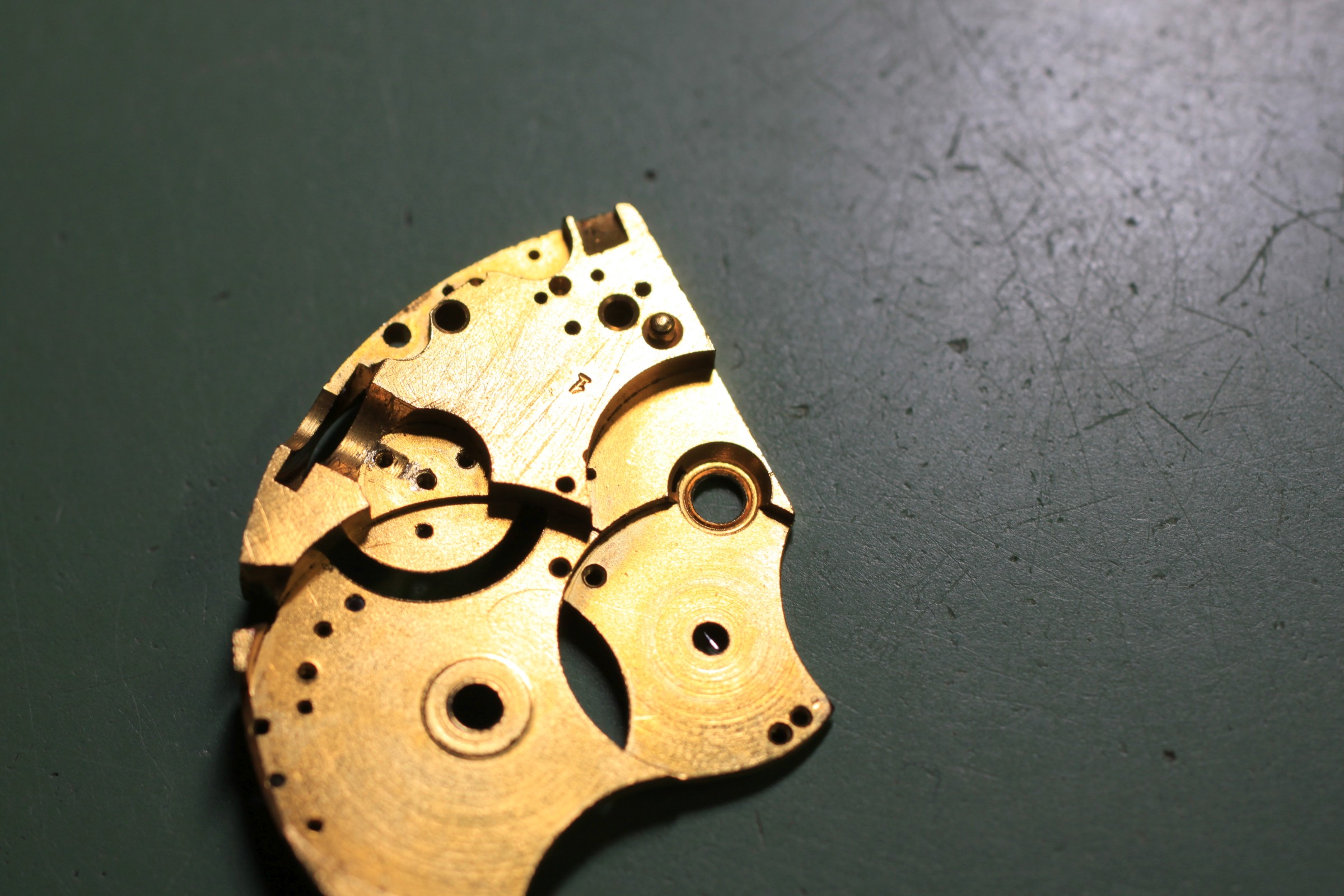
One ruby jewel was broken, with the crack extending into its hole. The sharp-edged chips make replacement unavoidable. This is again a set jewel, rather than a press fit as found in modern watches with synthetic rubies.
This pocket watch has a natural ruby, carefully drilled and shaped. Such jewels are too brittle to be pressed in, which is why a setting was always turned for them in earlier times.
The setting can be opened by tapping out the old ruby with pegwood, then very carefully and evenly turning out the rim of the setting so that the new jewel can be inserted.
With care, an existing setting can be opened and closed again almost without trace.
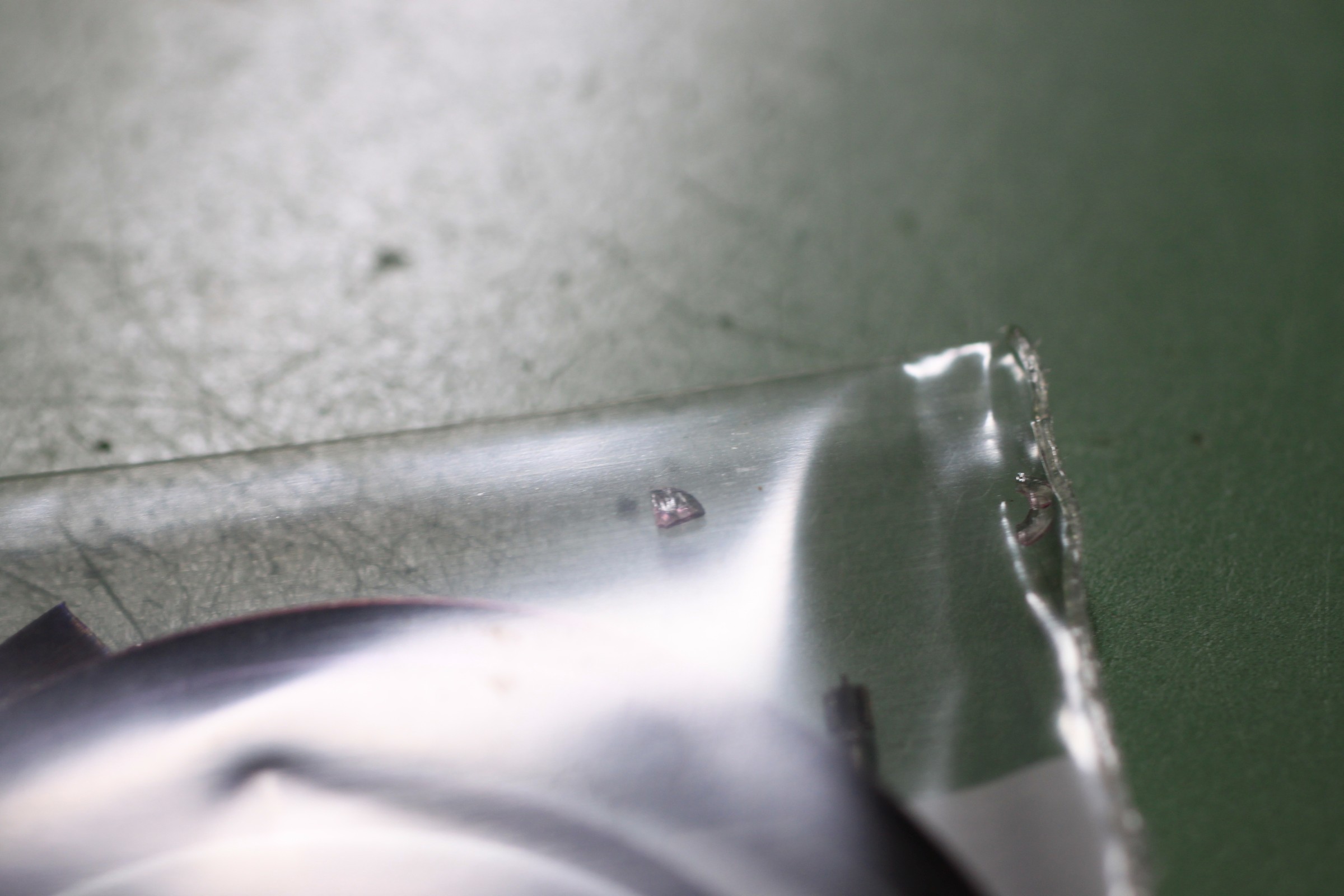
The old ruby goes into the spare-parts bag.
A ruby with an excellent colour match and the correct hole was still available in stock. The setting was closed on the watchmaker’s lathe with a faceplate, a specially made burnisher and plenty of oil. Before this, it must be ensured that the ruby sits absolutely flat and straight in the setting.
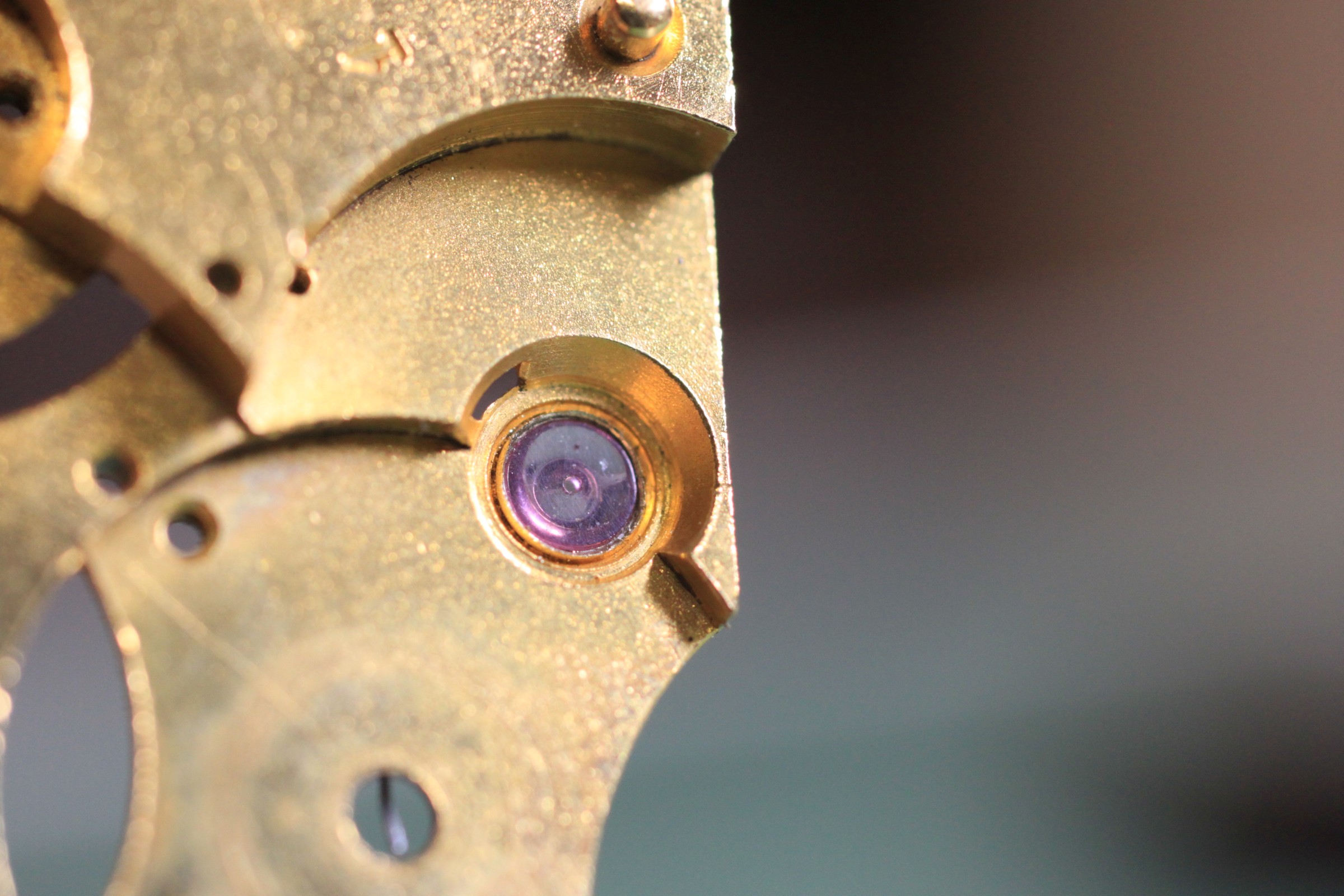
Comparing the colour with one of the old ruby jewels reveals no difference between new and old.
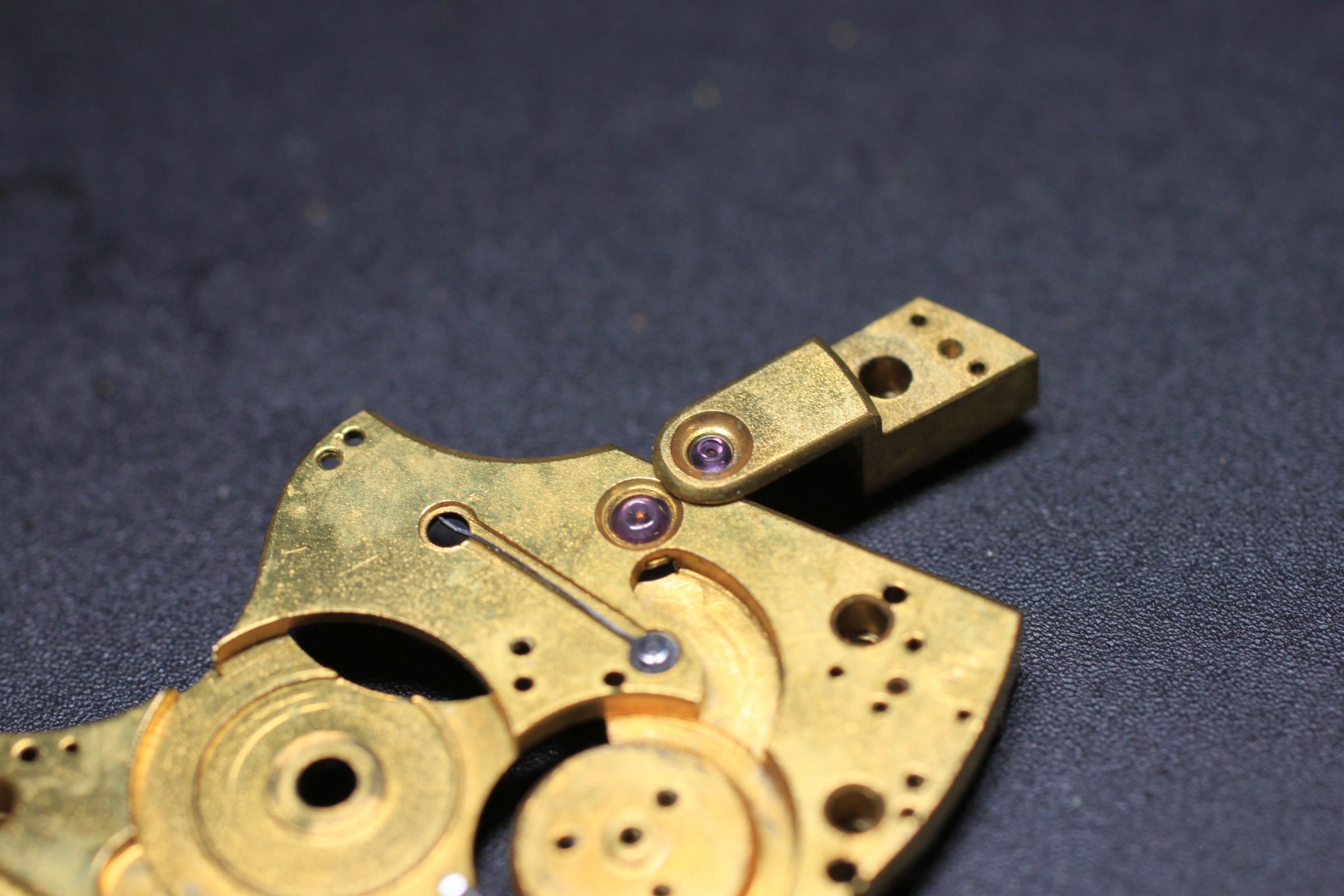
At the very end, once all components have been removed, the unobstructed view is used to ensure that the balance spring is absolutely flat and concentric.
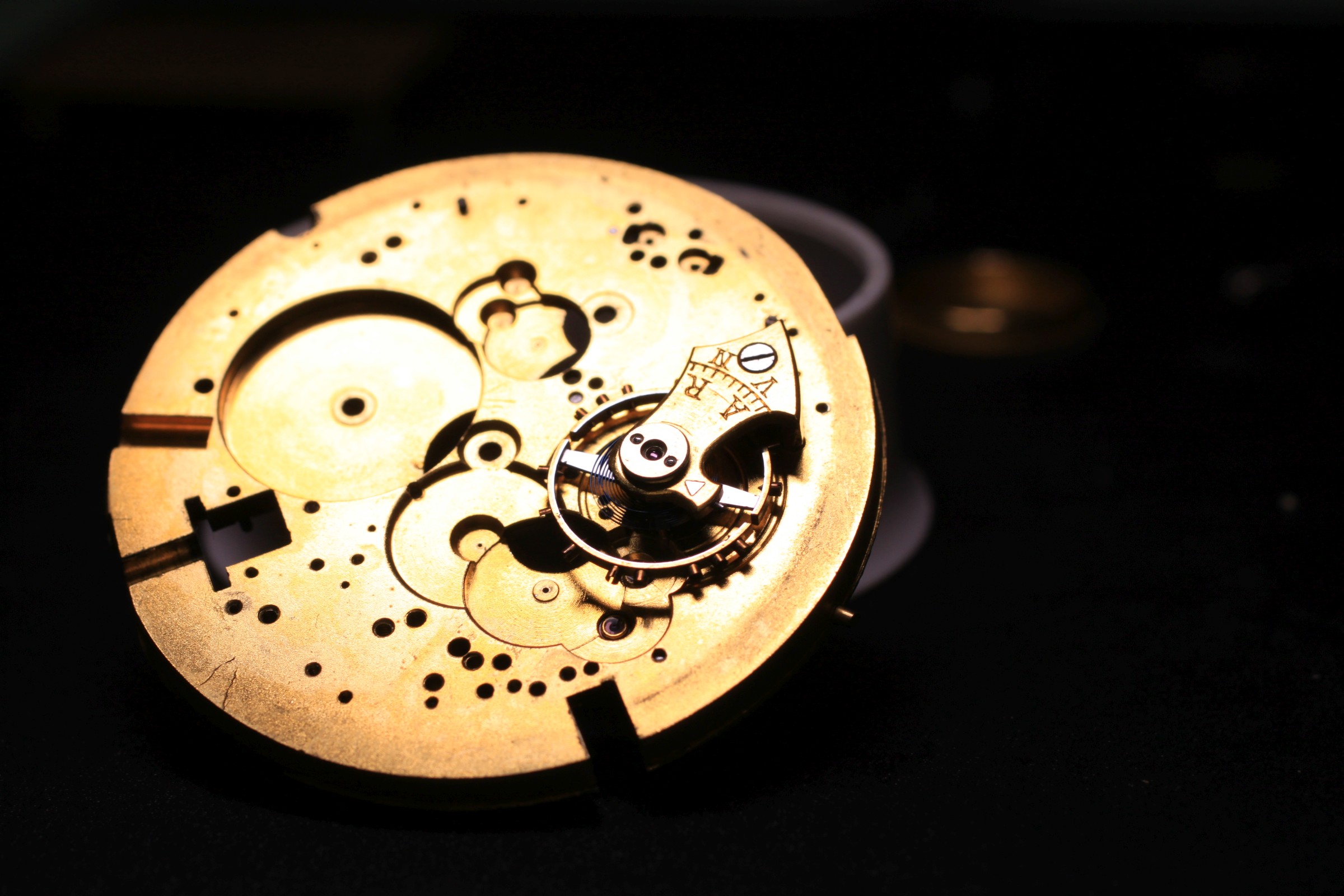
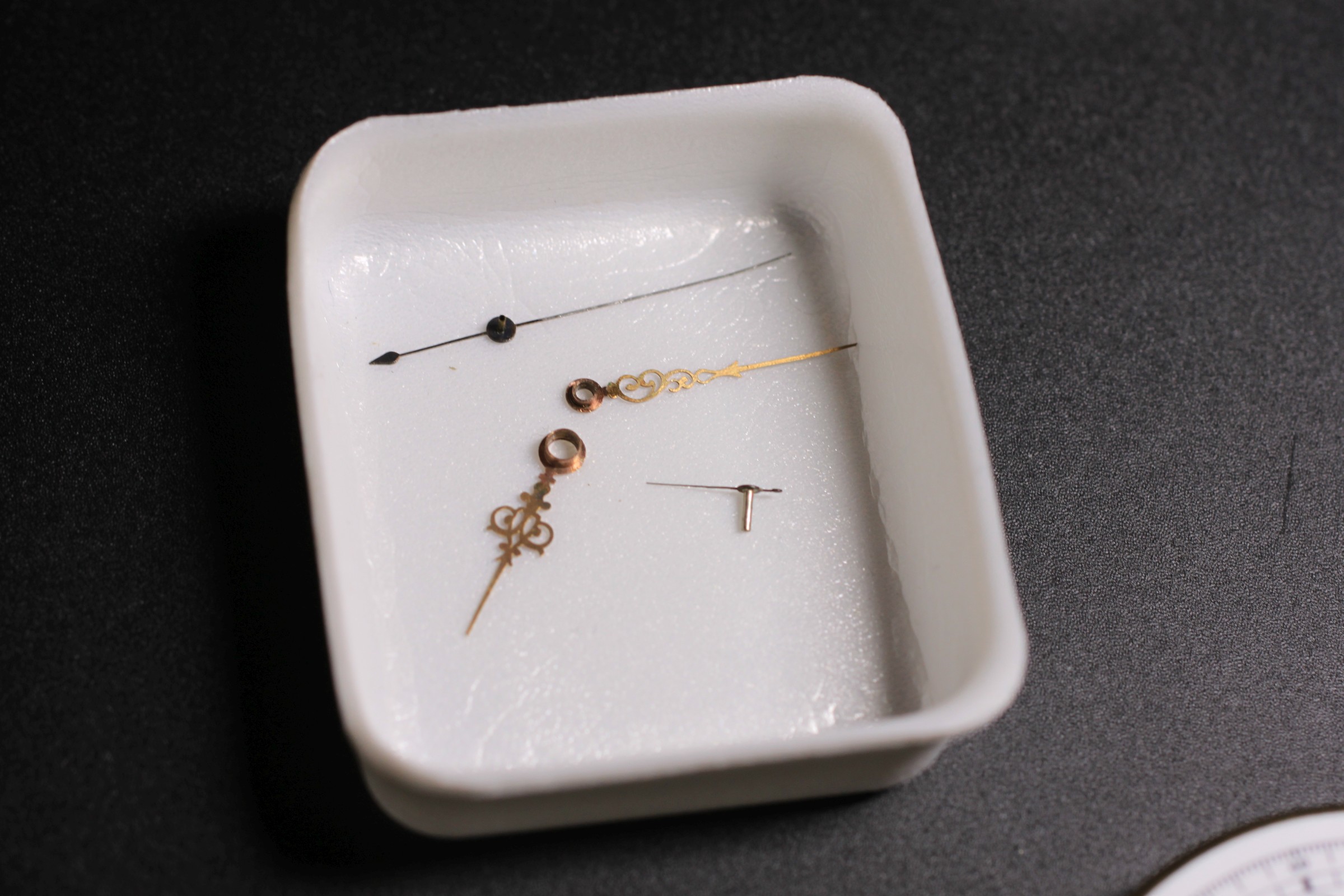
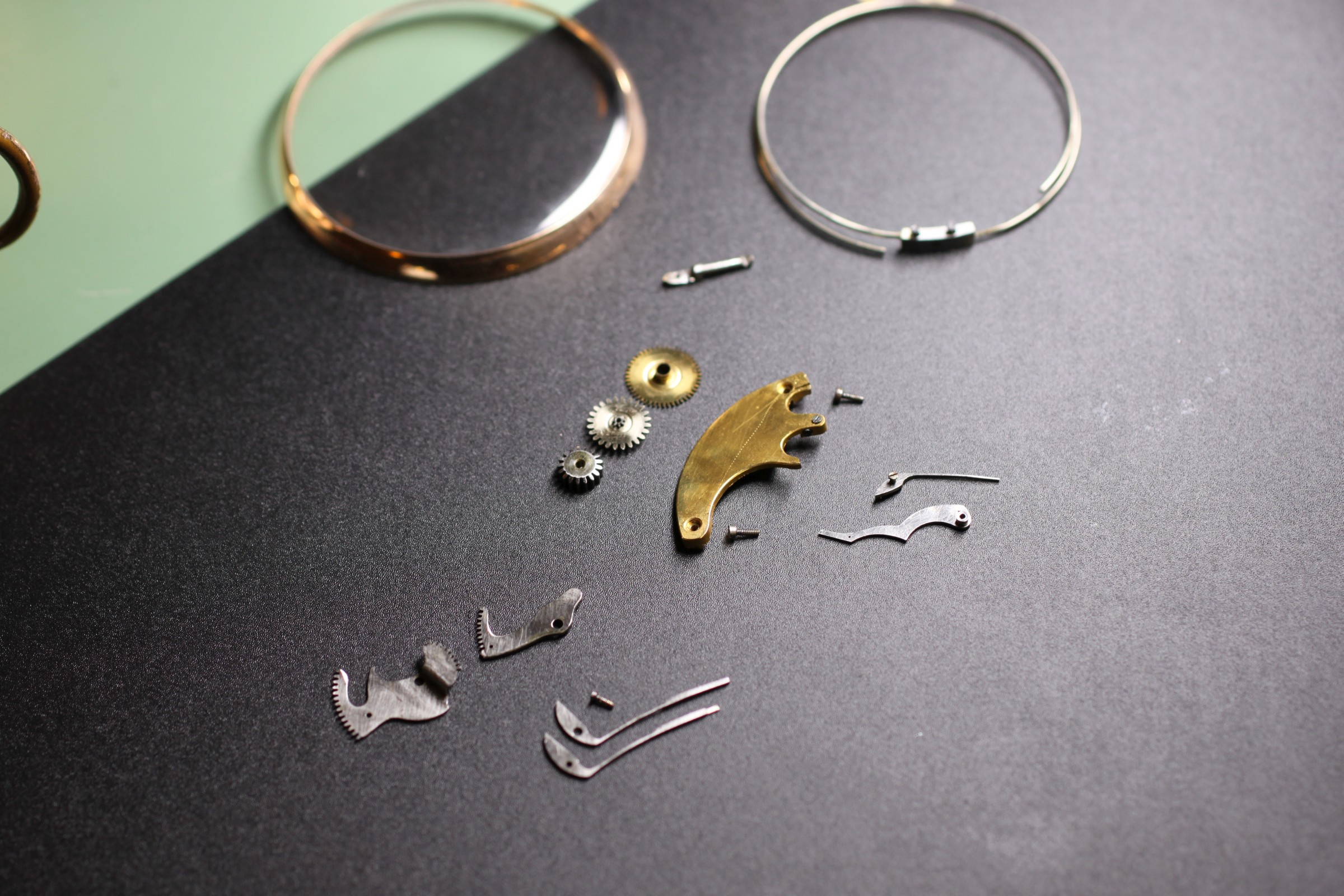
The components of the disassembled minute repeater
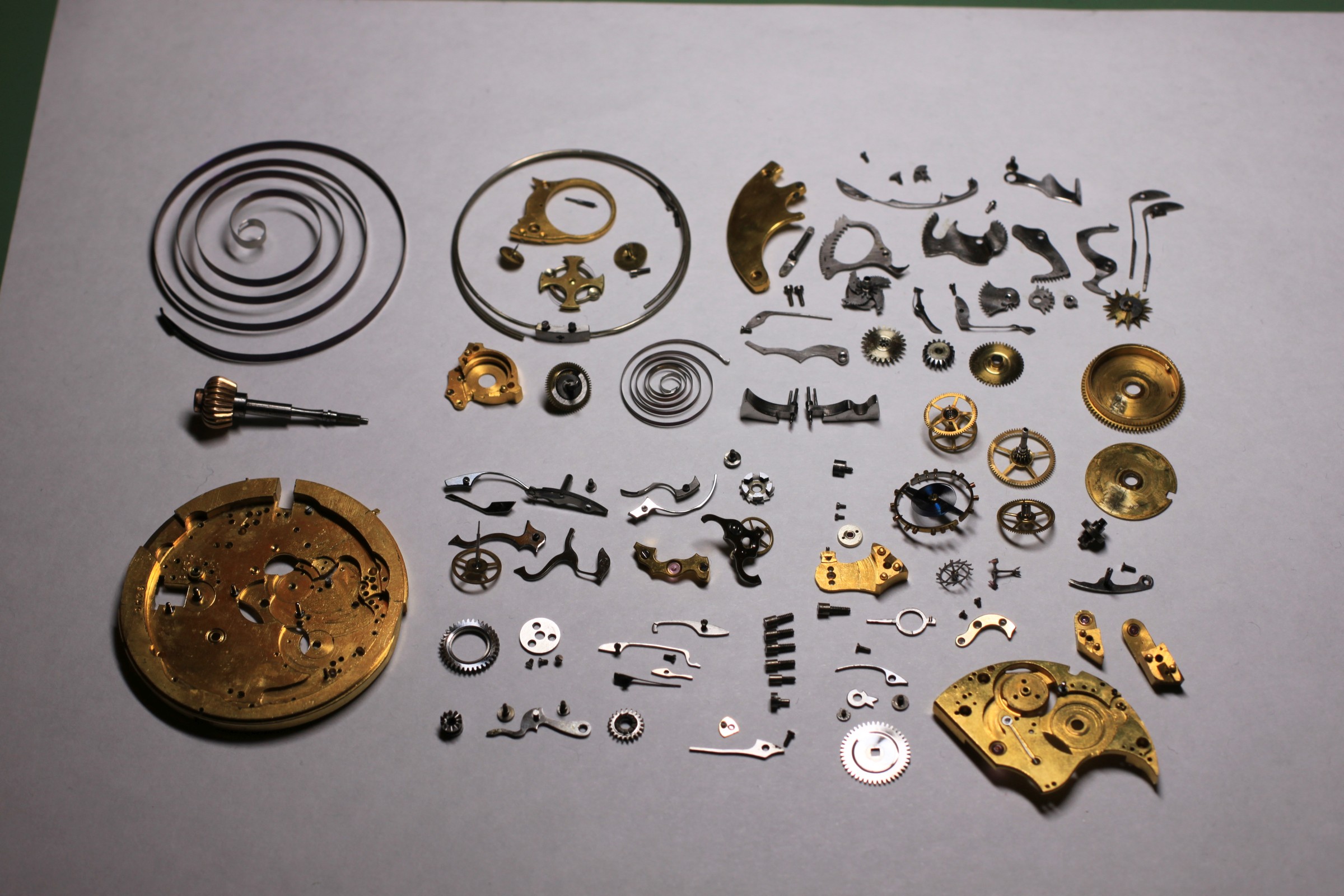
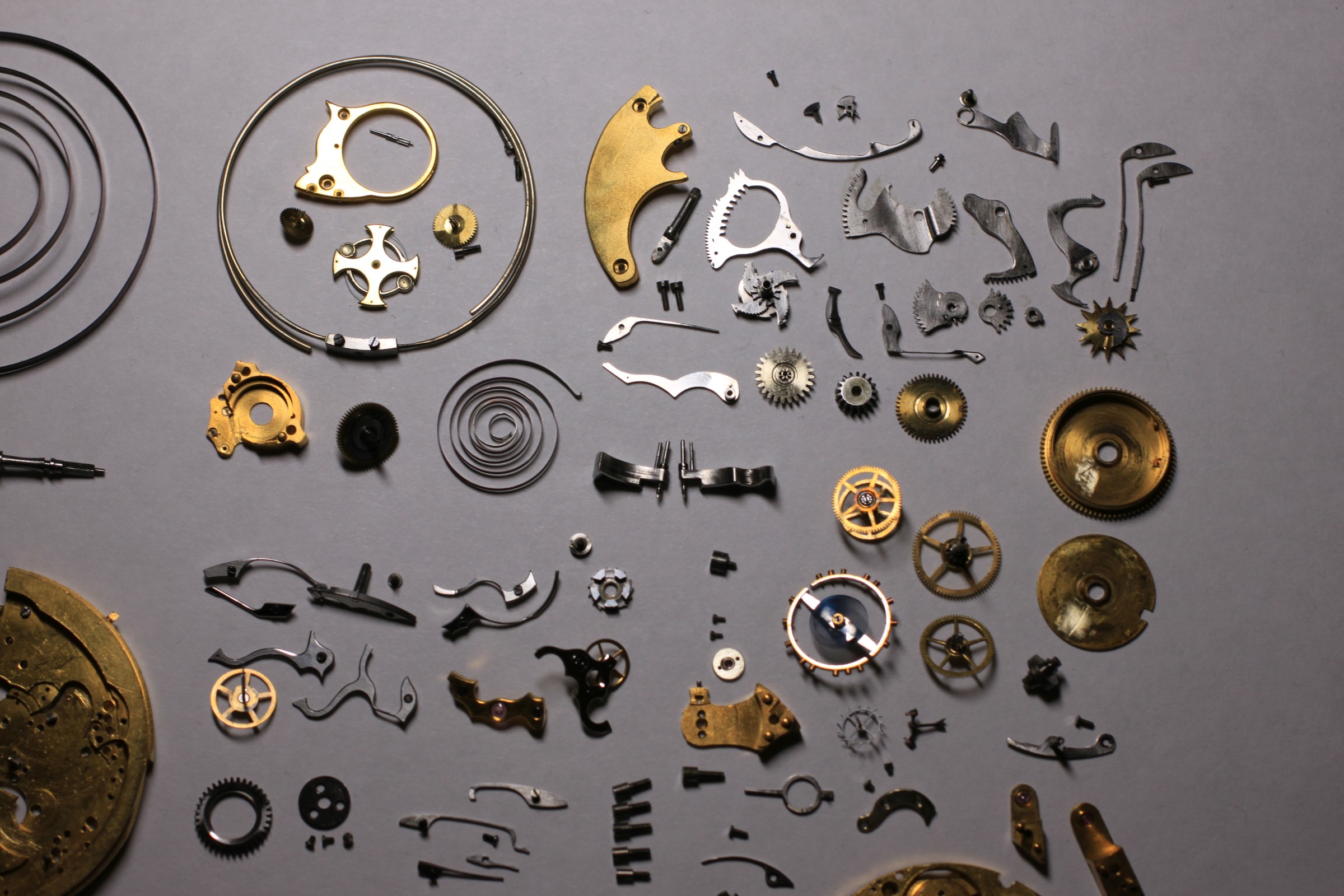
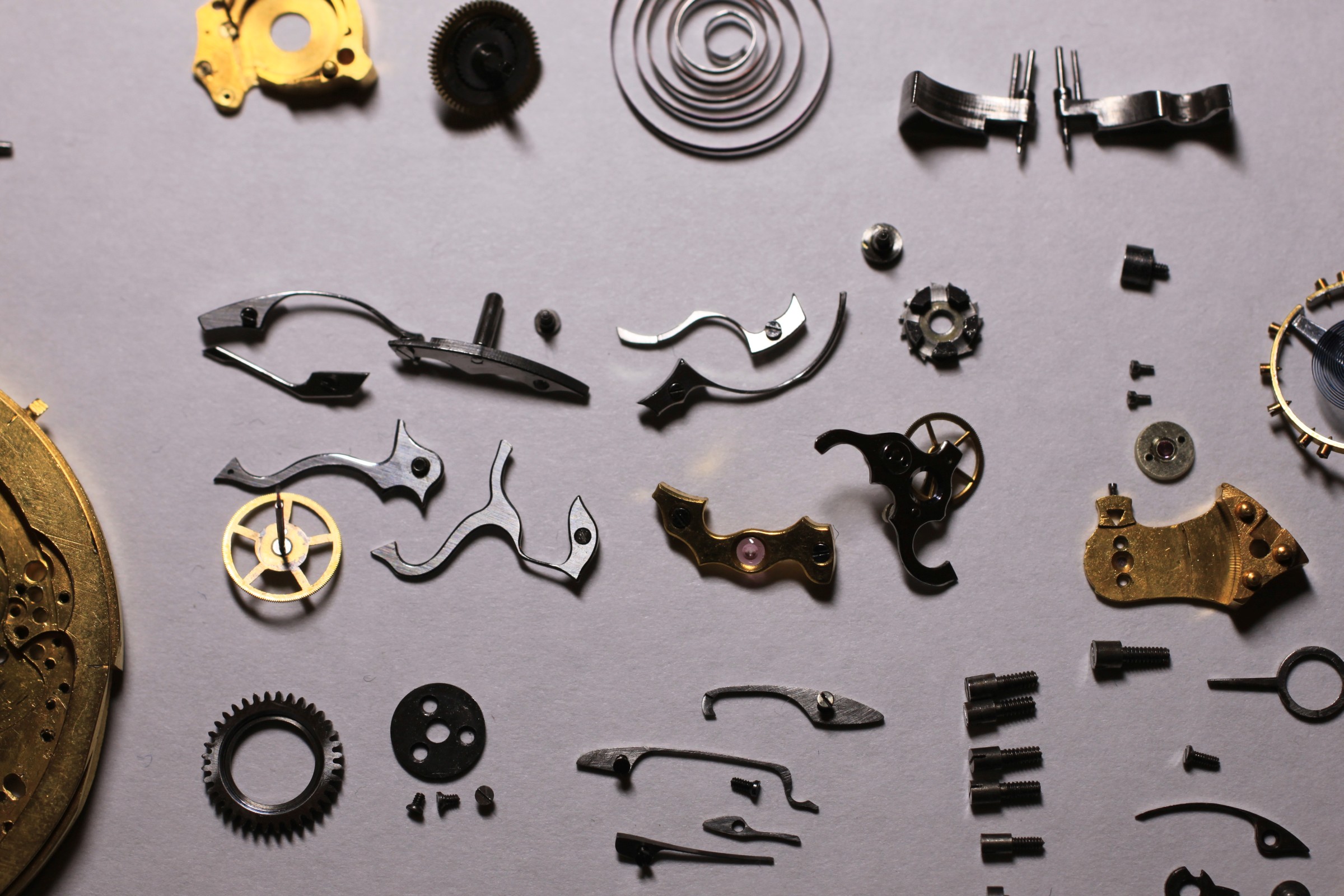
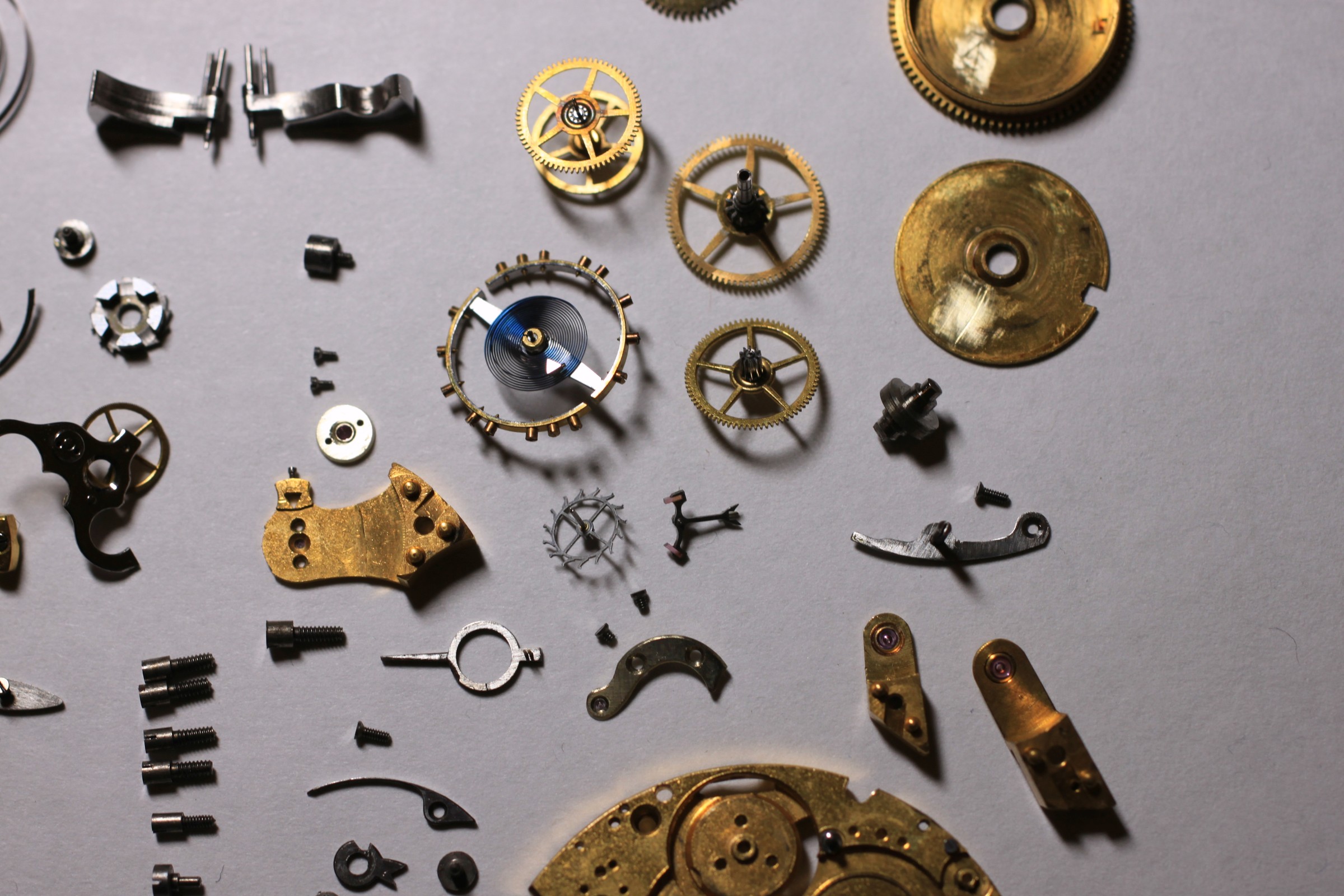
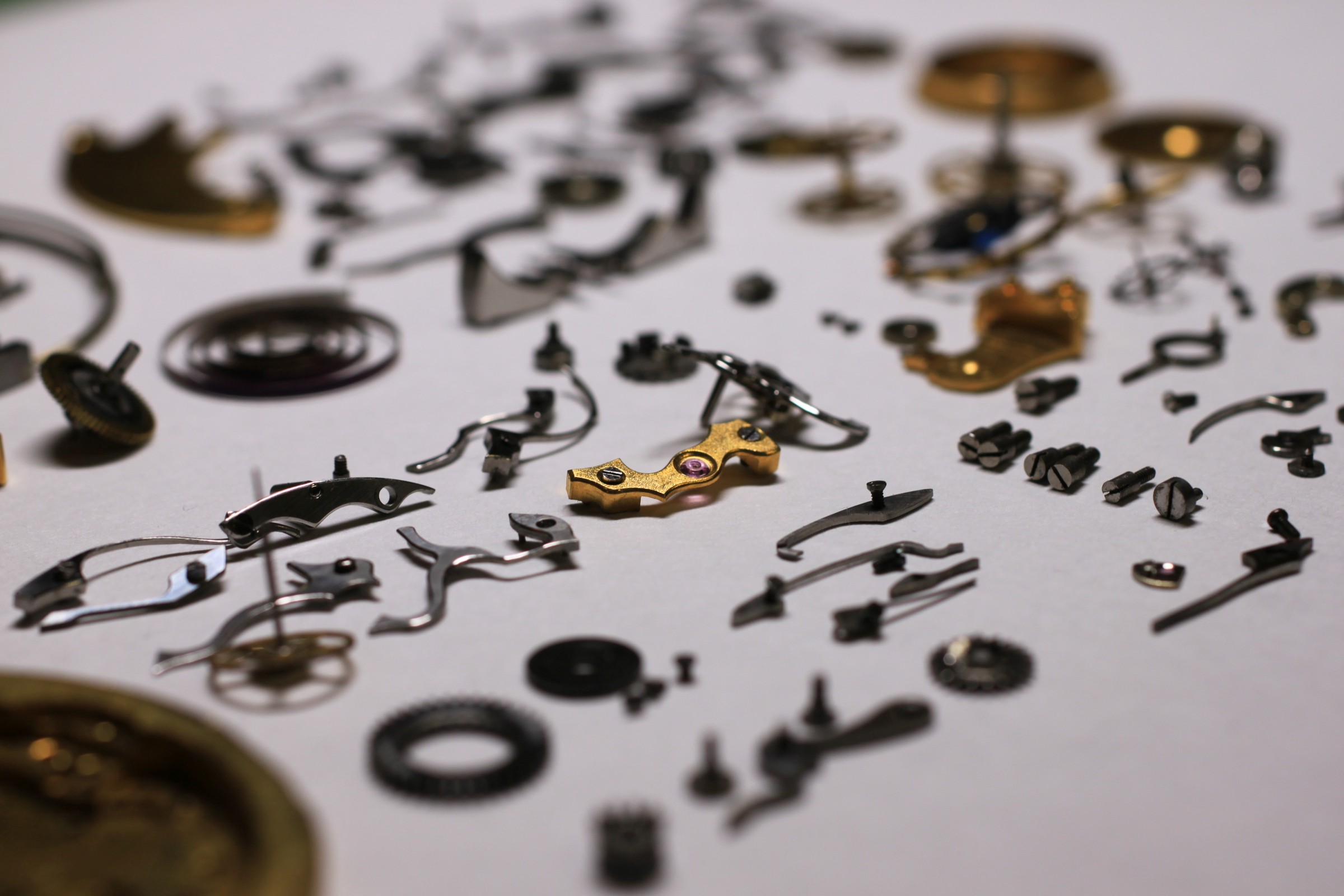
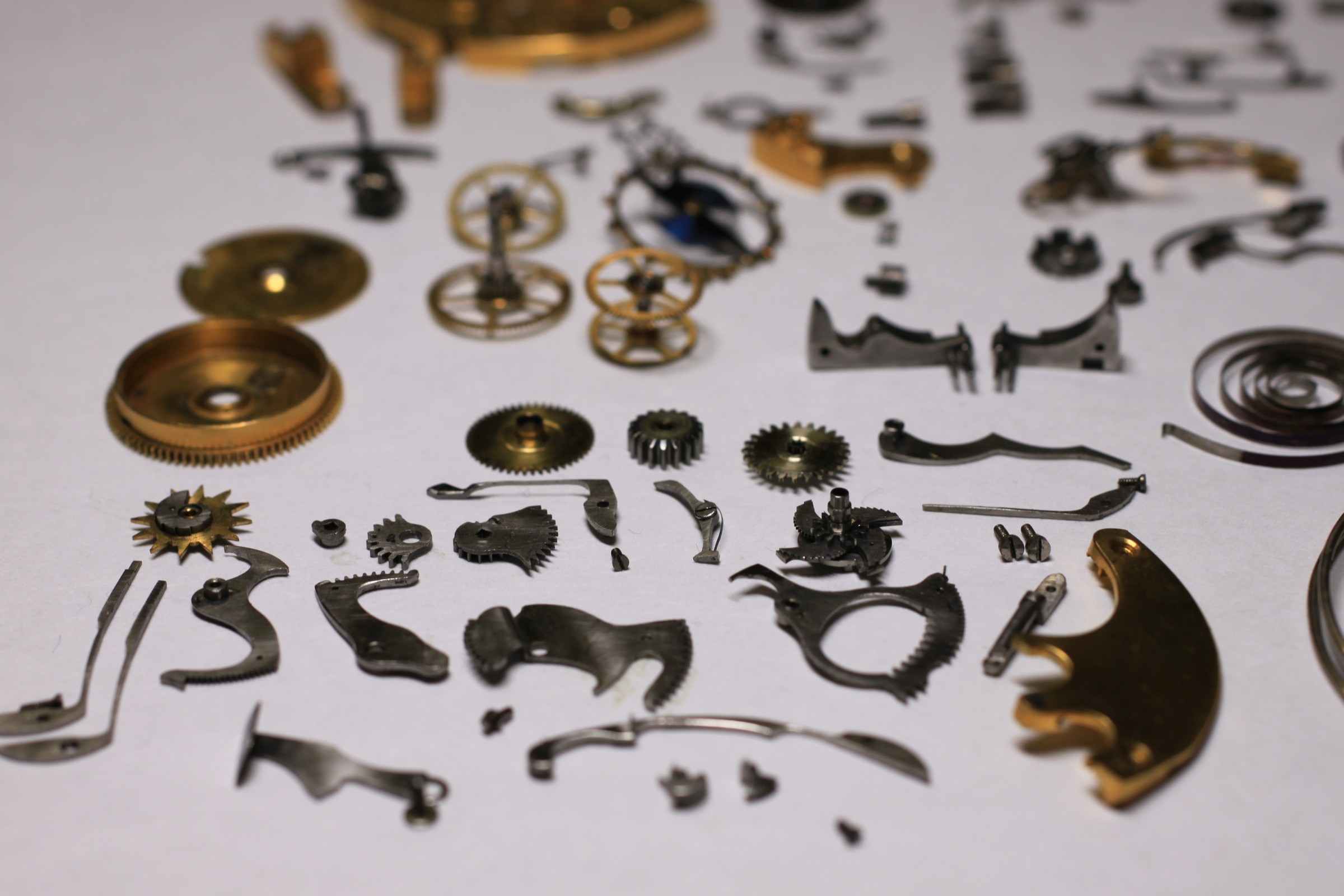
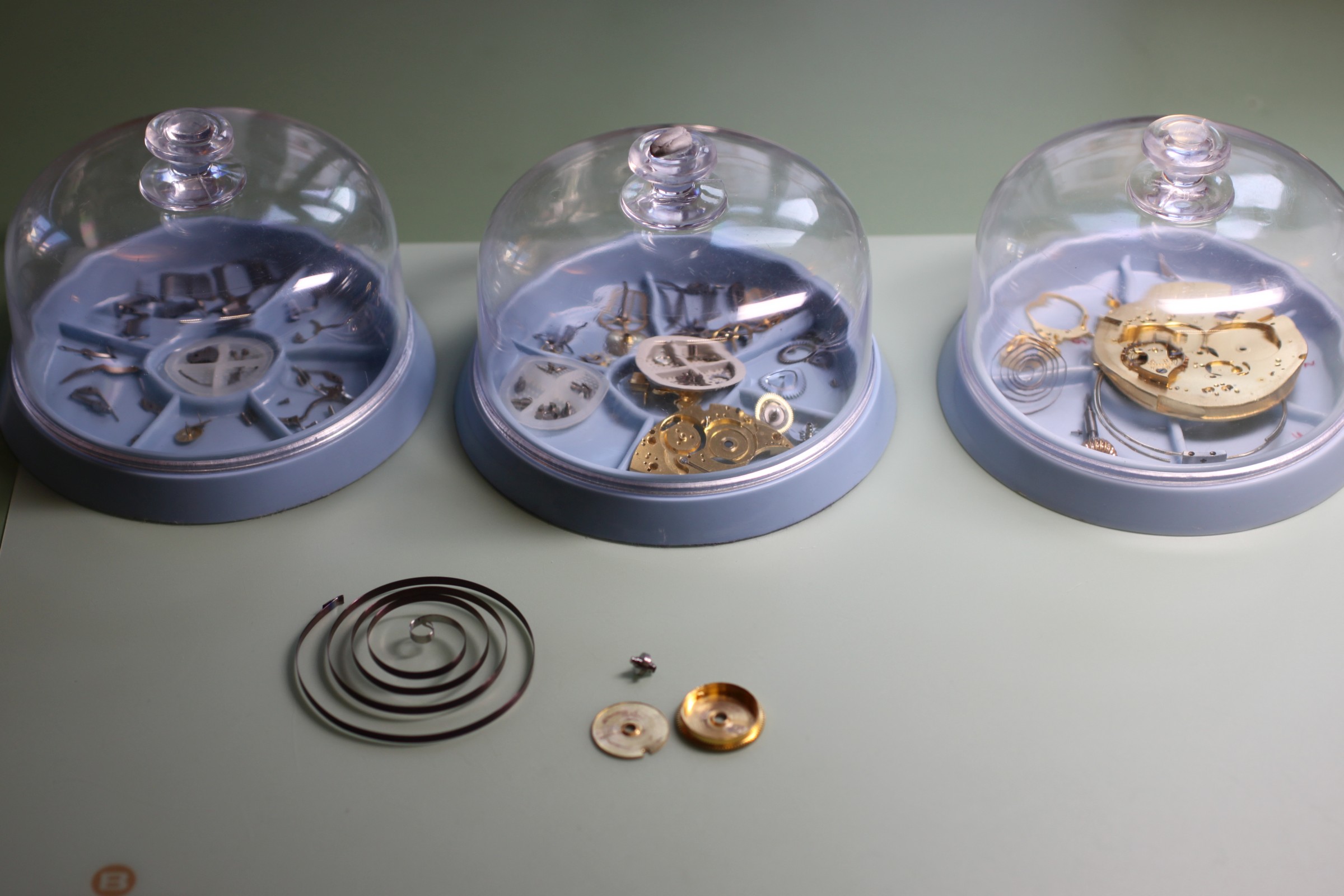
After cleaning, the components are sorted beneath dust covers. To achieve the best possible oil retention over many years, I always apply epilame treatment to almost all watch components. An oil drop on an epilame-treated surface does not spread, but stays in place however long the watch runs.
I have an epilame-treated test plate with a very thin oil, on which a drop of that oil has remained unchanged for ten years. Alongside it, on the untreated surface, there was also an oil drop. After only a few years, it had spread over the whole surface and was no longer visible.
Assembly then takes place: the movement is assembled and the final adjustments are made. Most of the work was already carried out during disassembly and repair so that assembly can proceed cleanly and briskly. At this stage, one does not want to start experimenting or testing: the movement should already function.
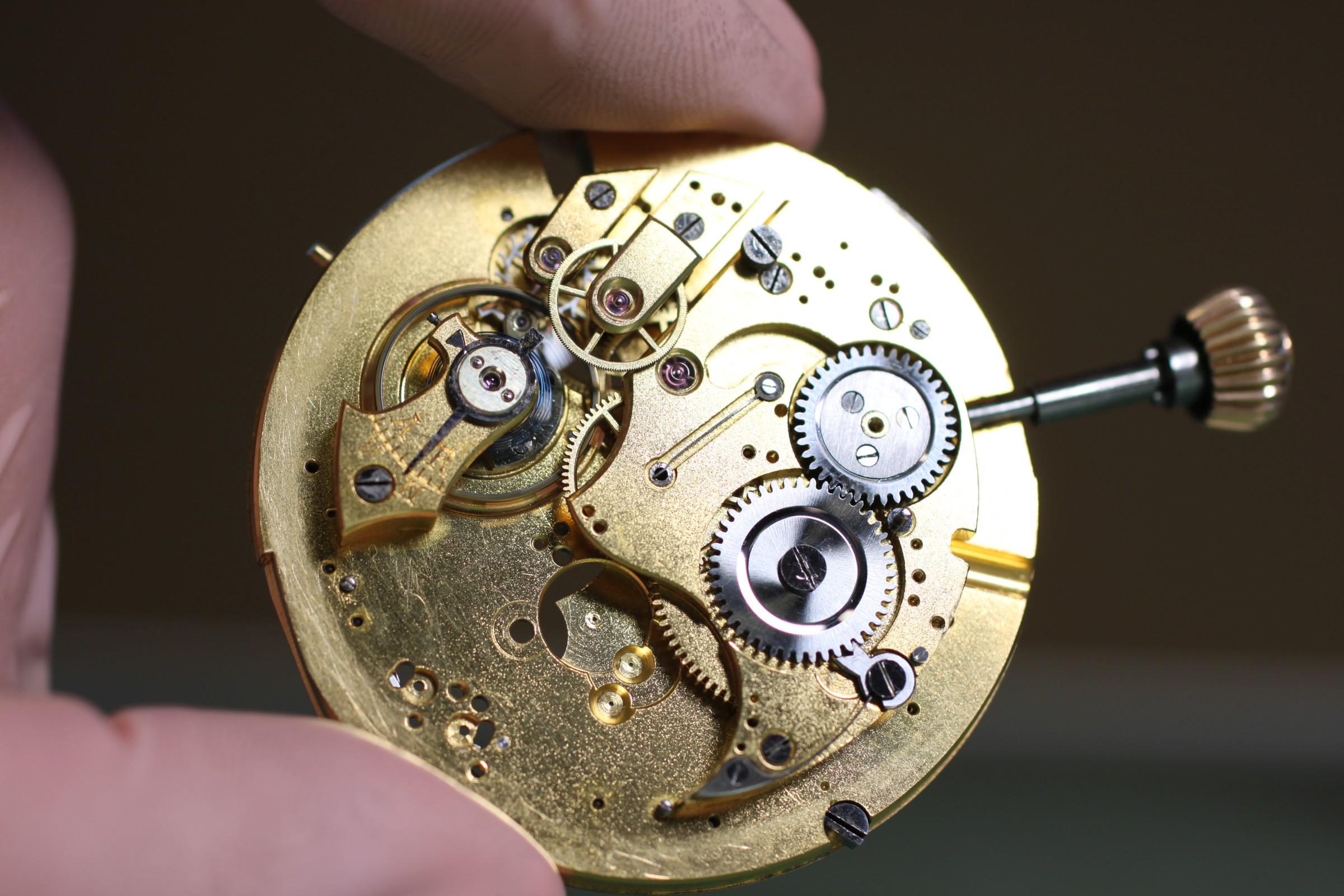
The movement is now assembled and lubricated in the reverse order of disassembly.
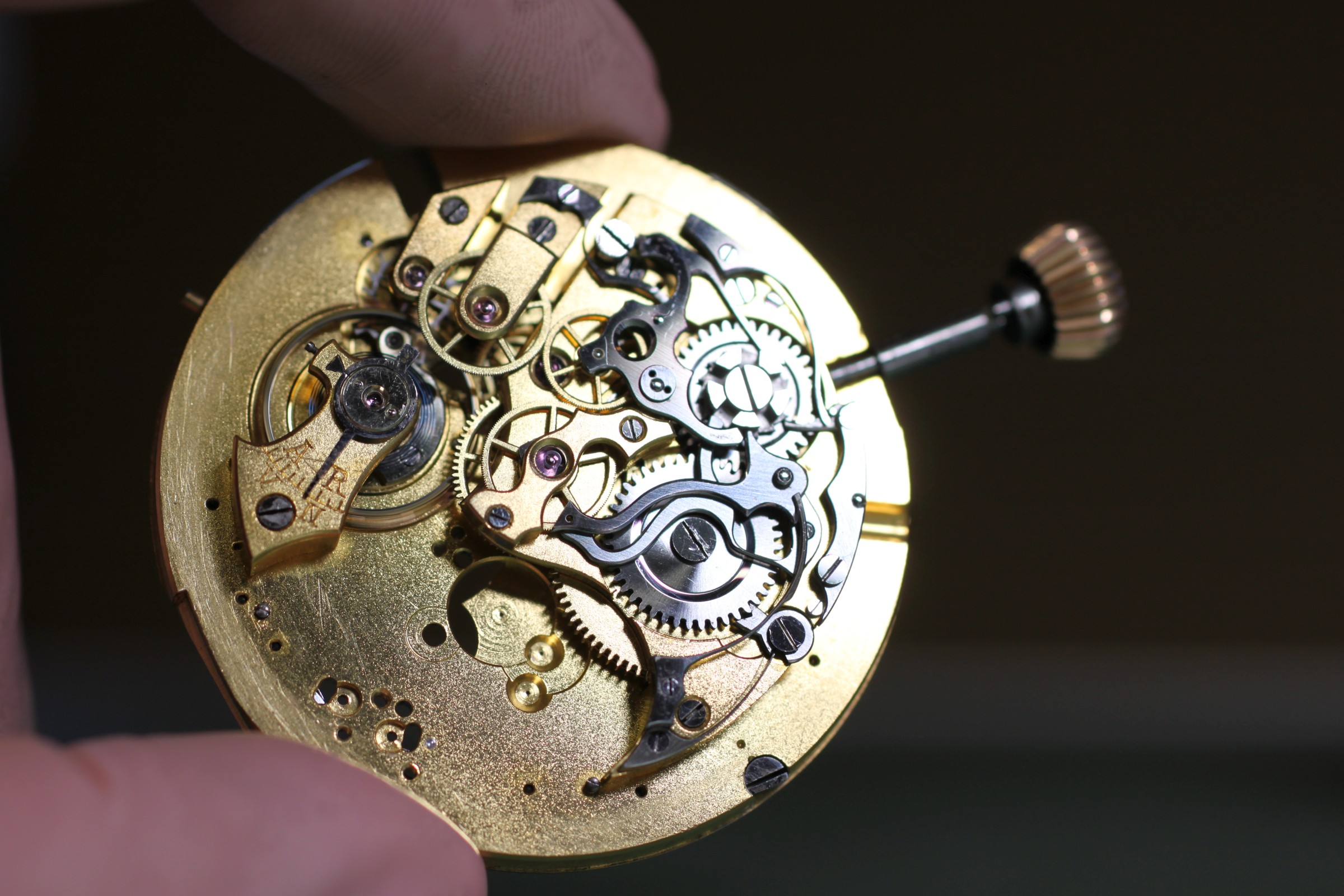
After cleaning, old oil, dirt and oxidation have been removed, and the movement shines once more in its former glory.
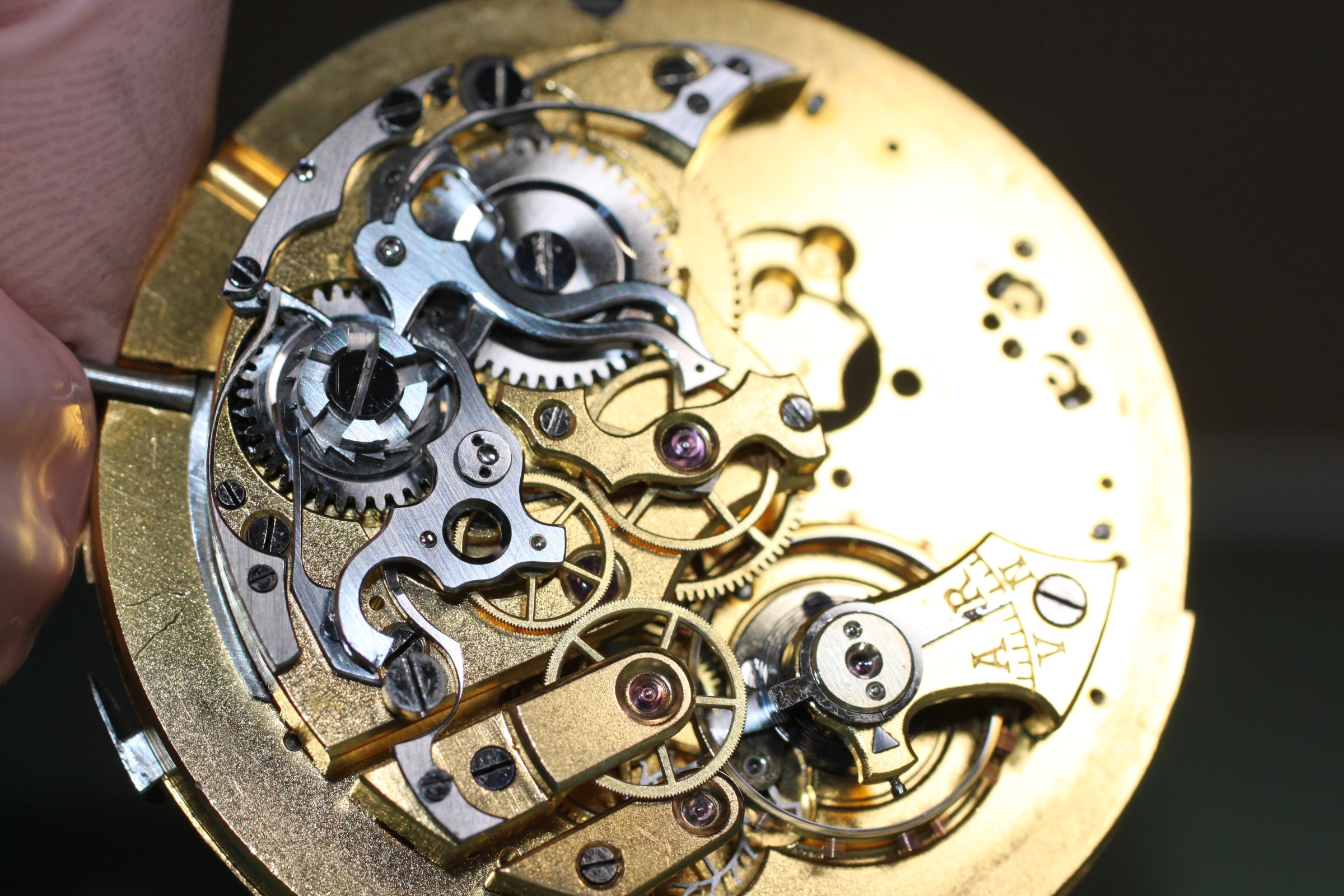
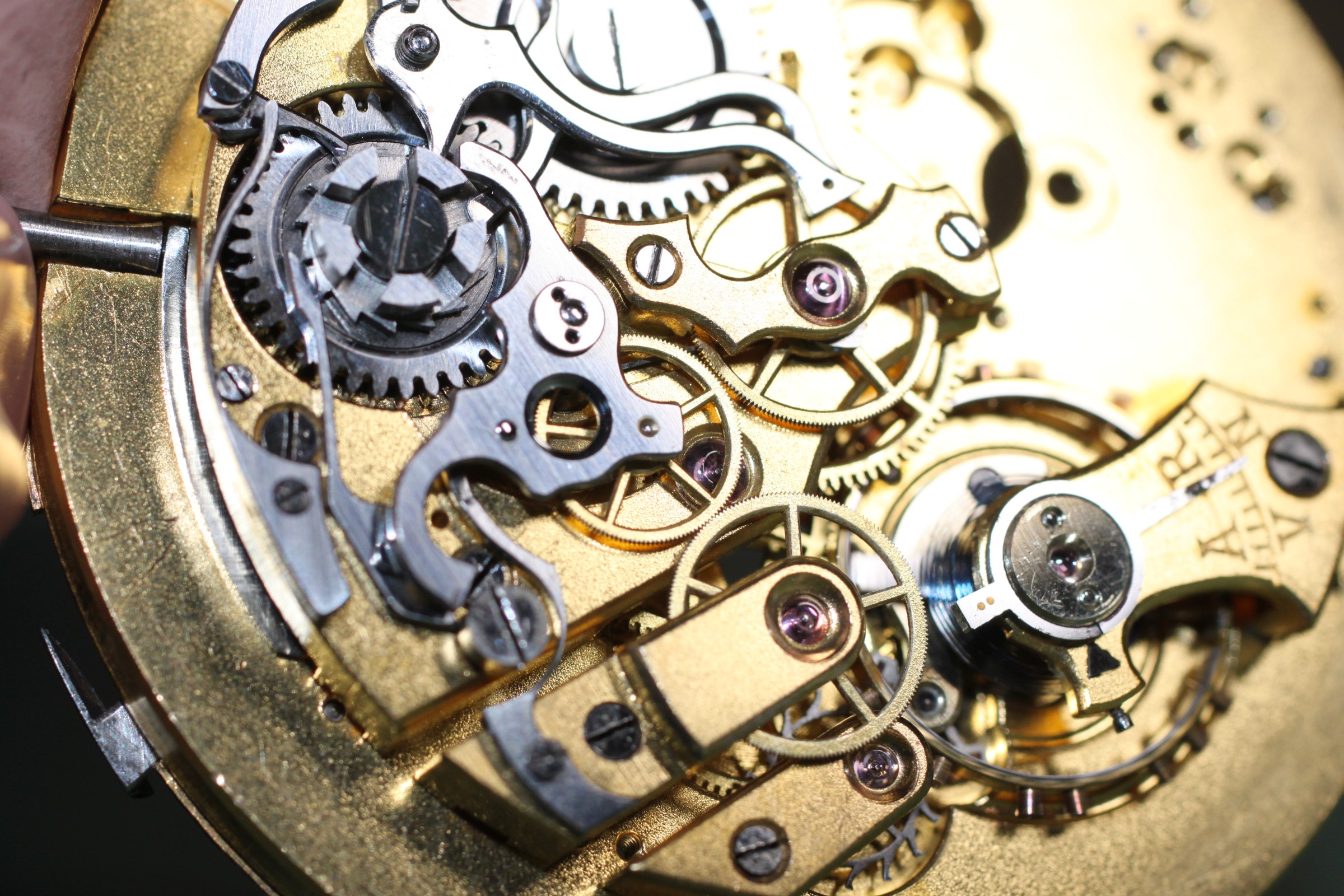
Handwork at this level is found today only in watches whose new price equals that of a mid-range car. With additional functions such as chronograph and minute repeater, the price quickly reaches six figures.
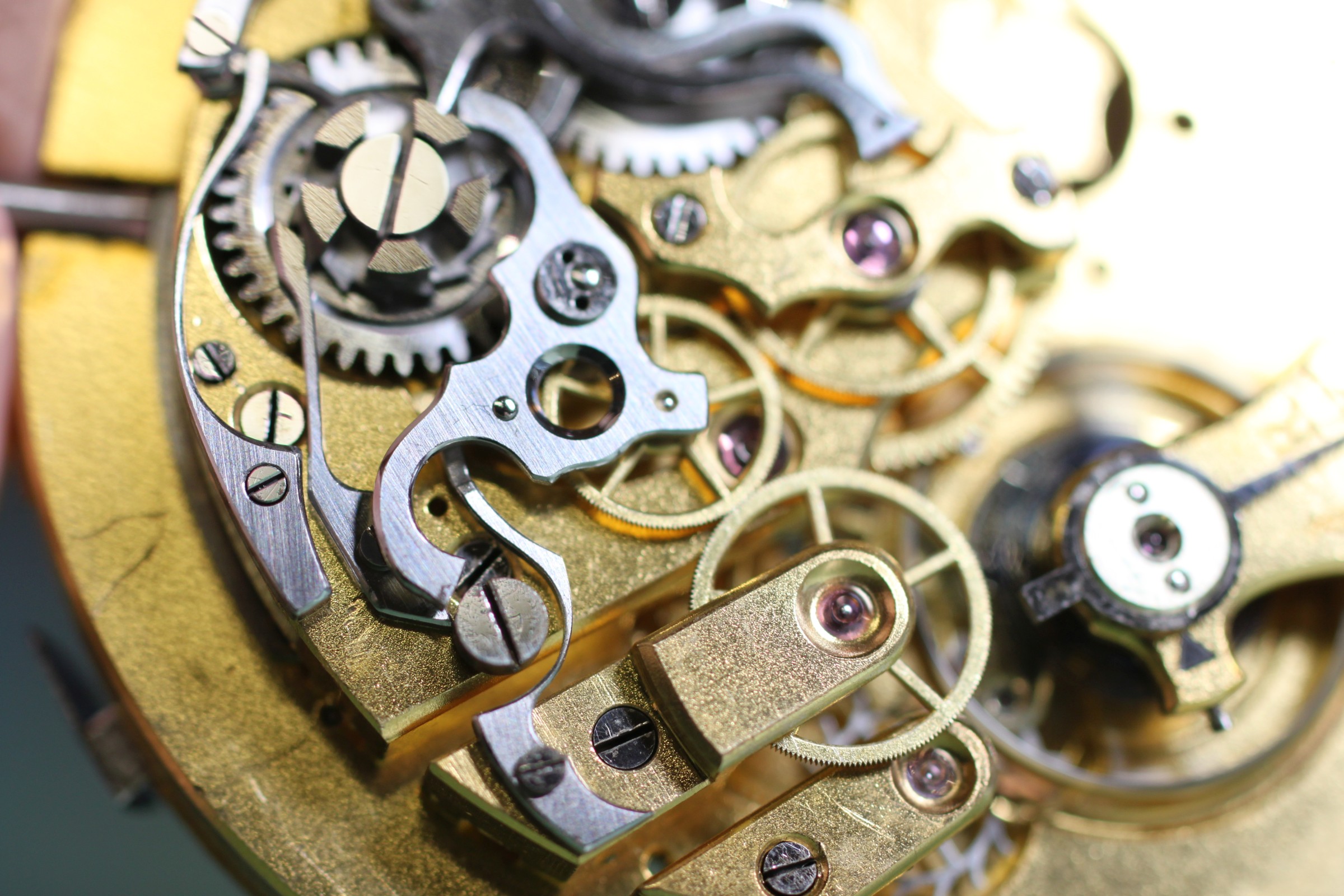
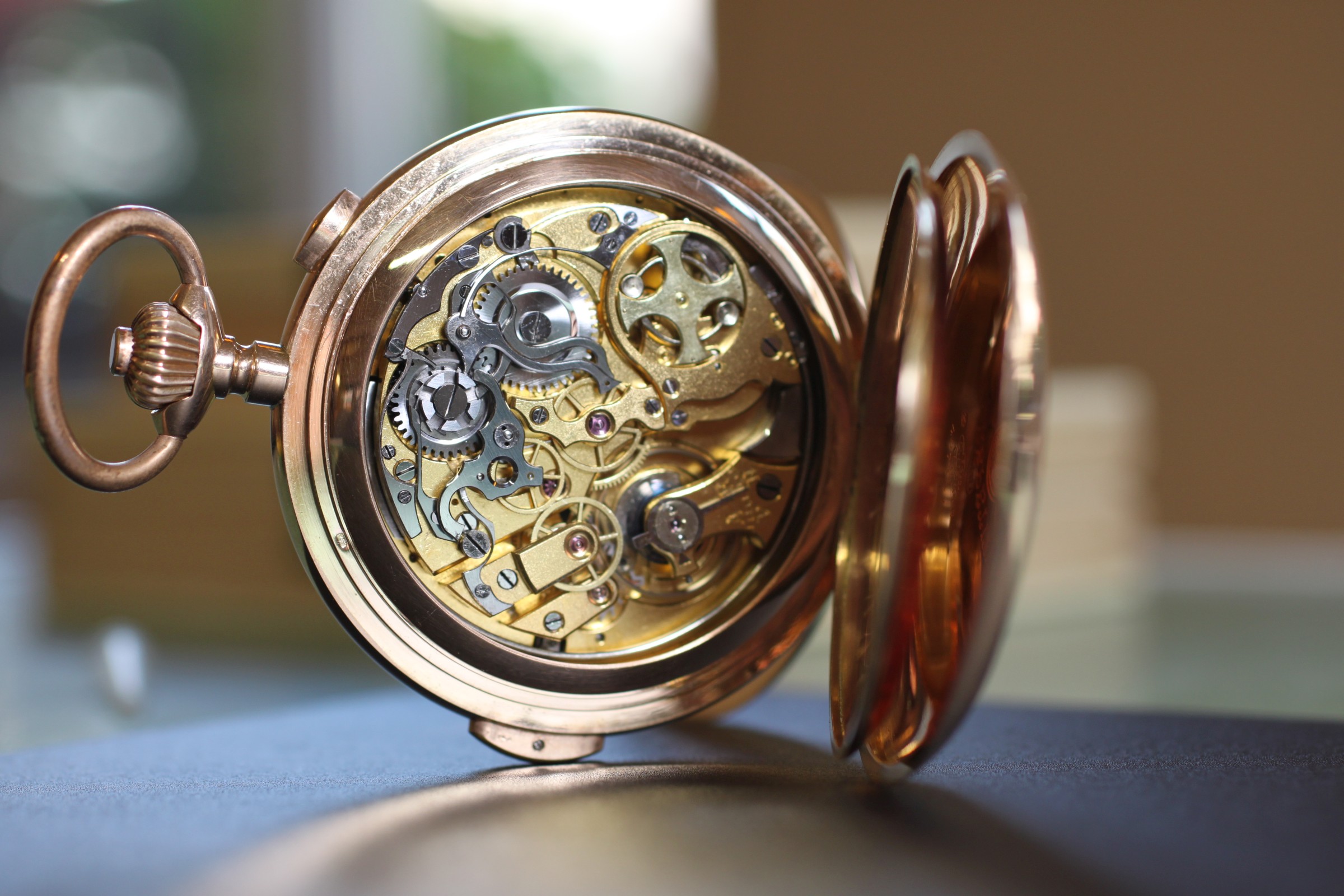
Further assembly needs no more commentary. The movement is a feast for the eyes.
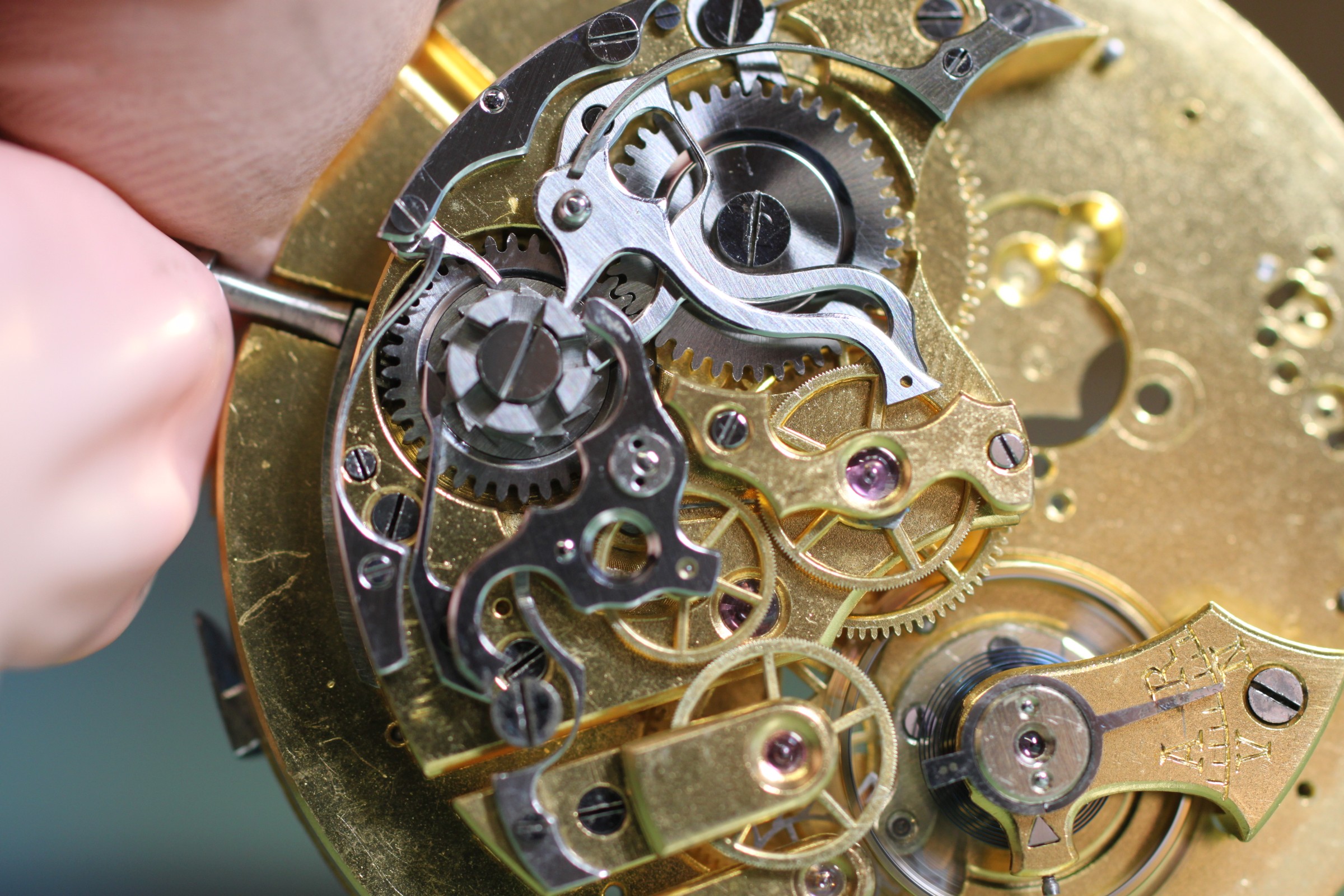
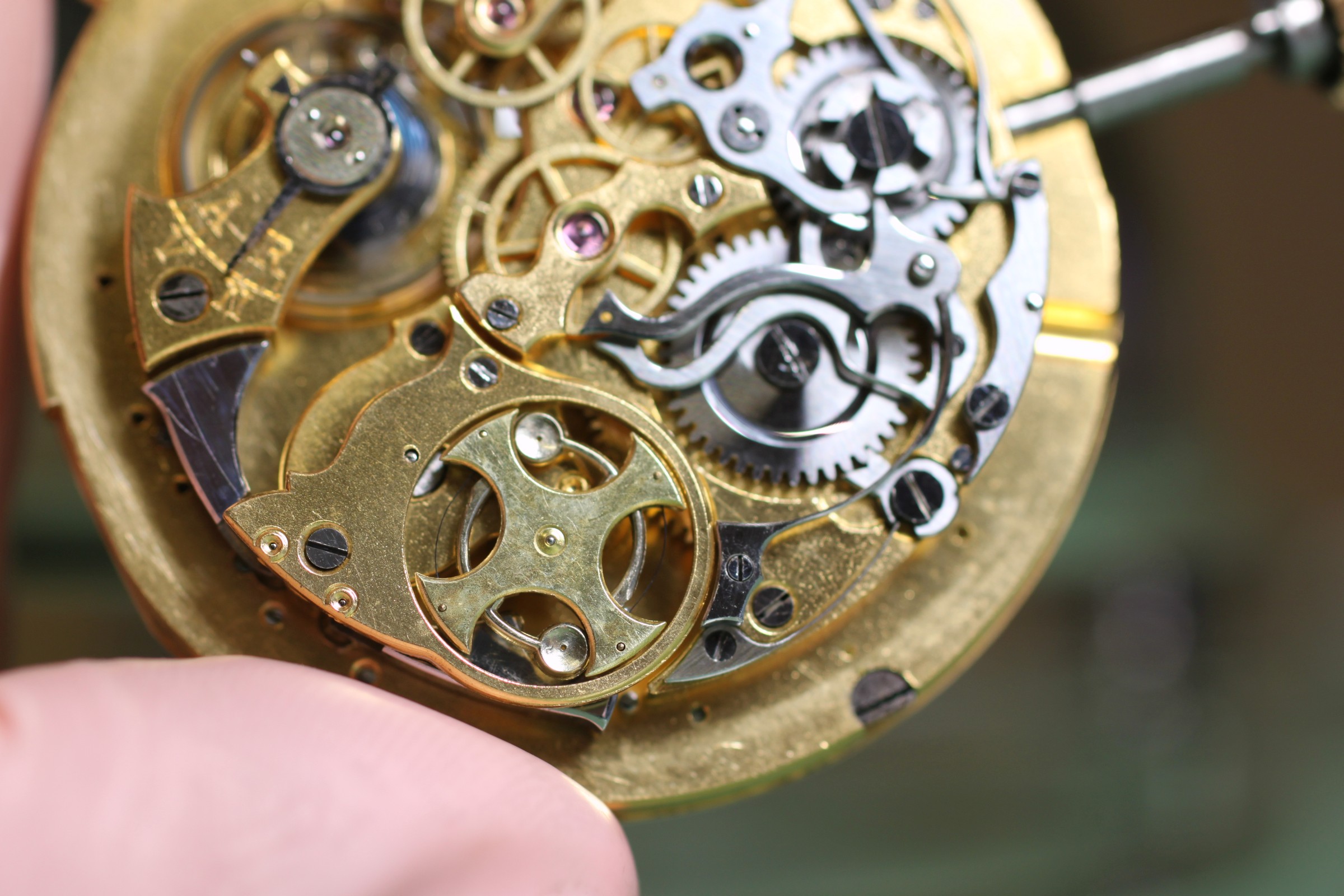
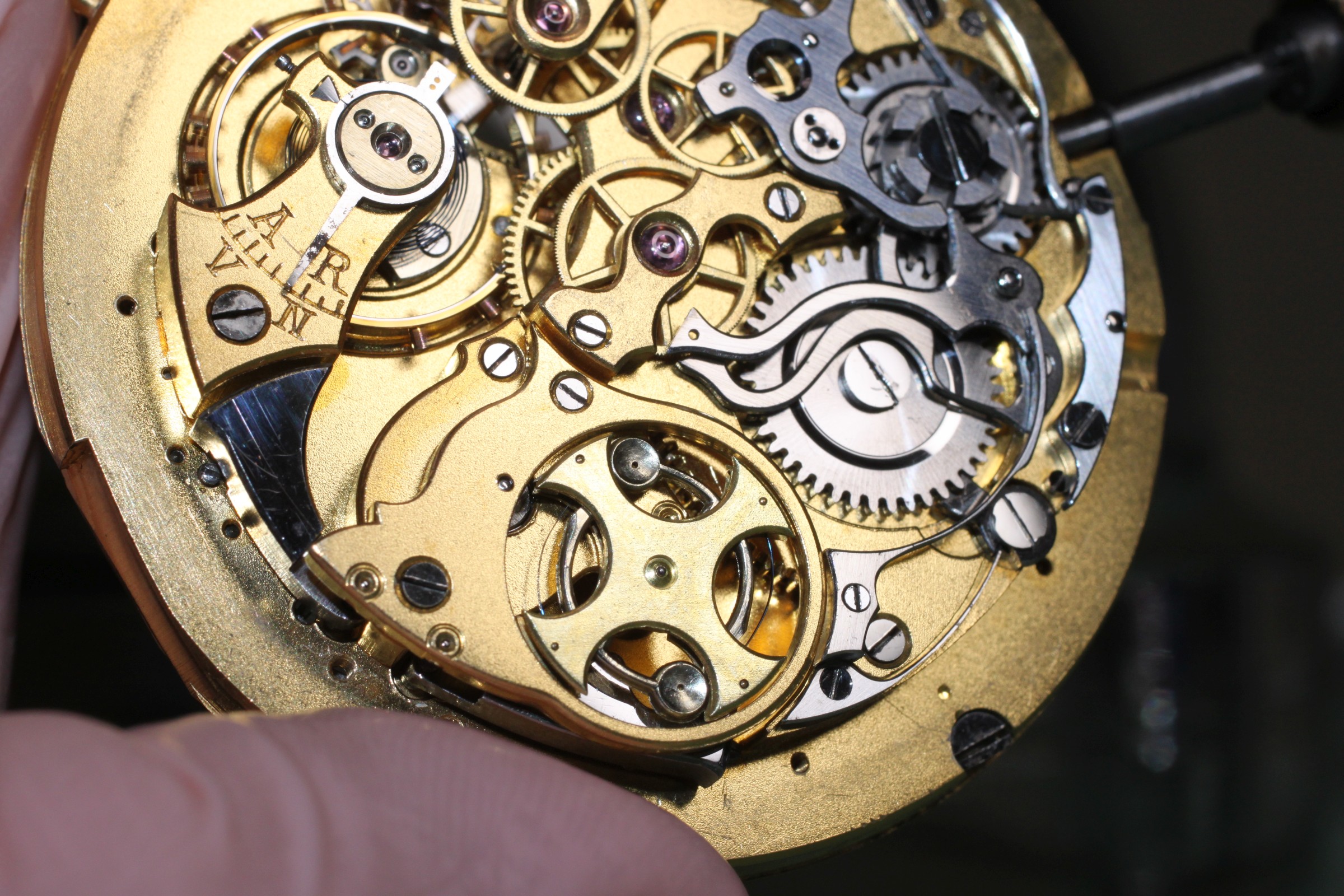
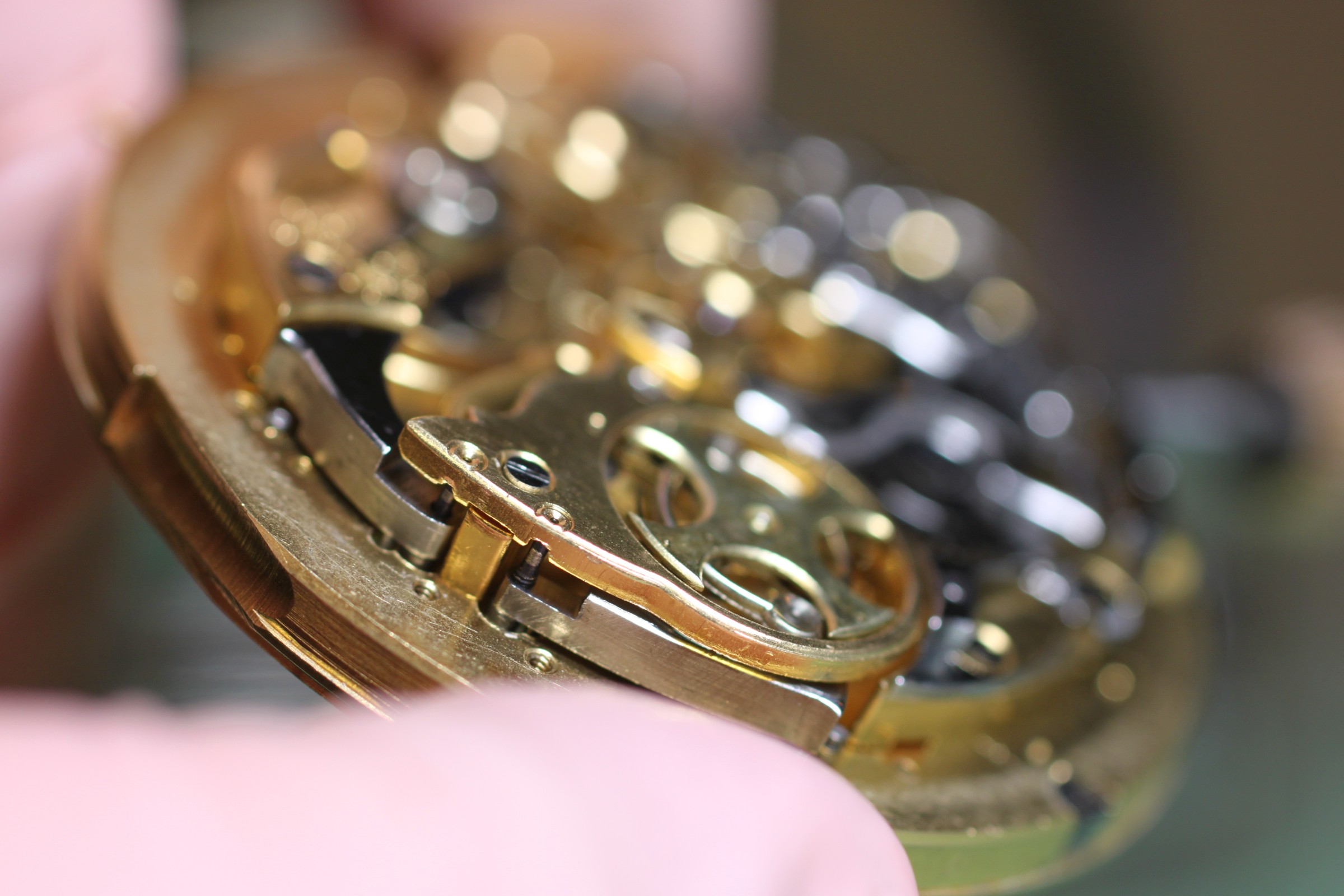
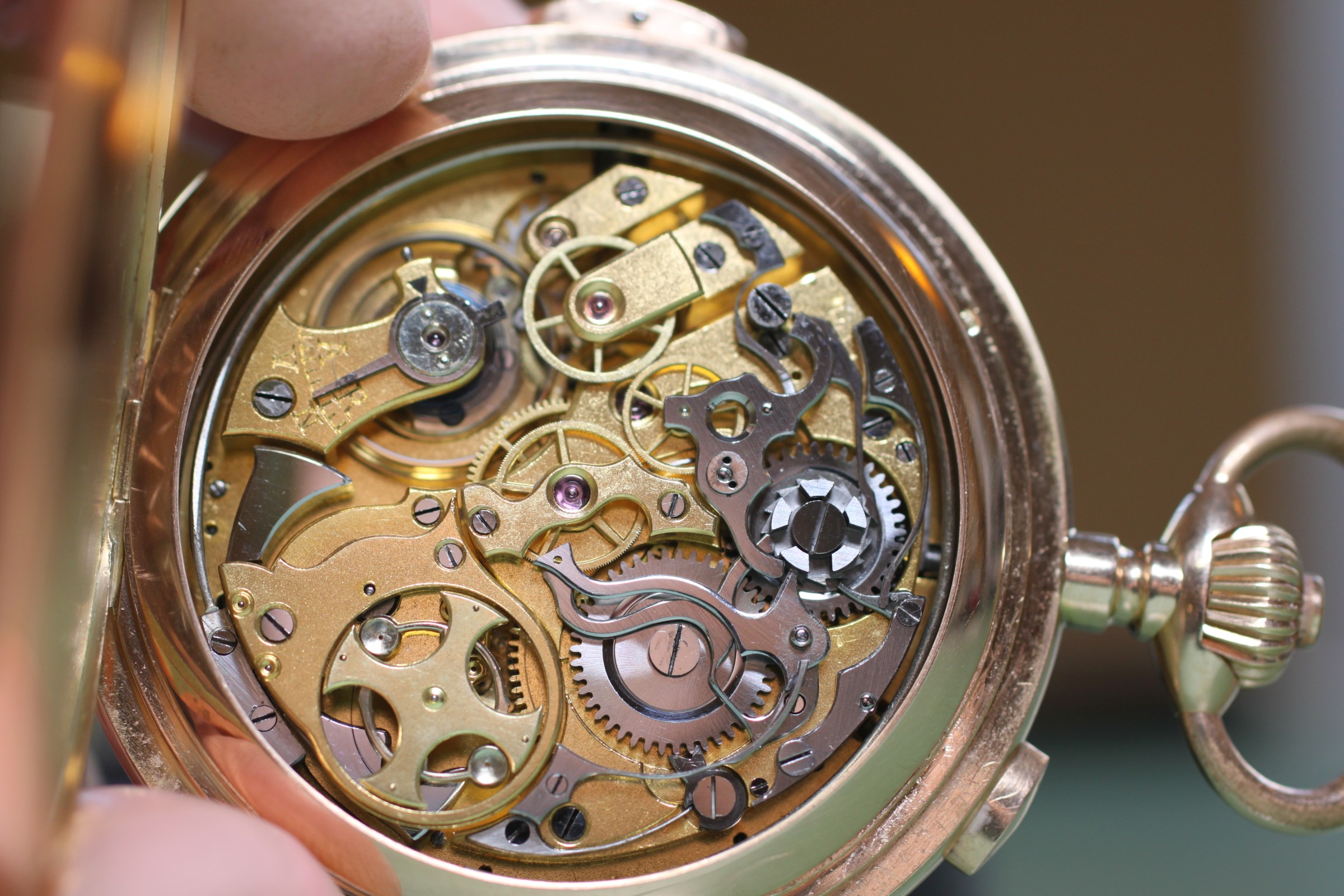
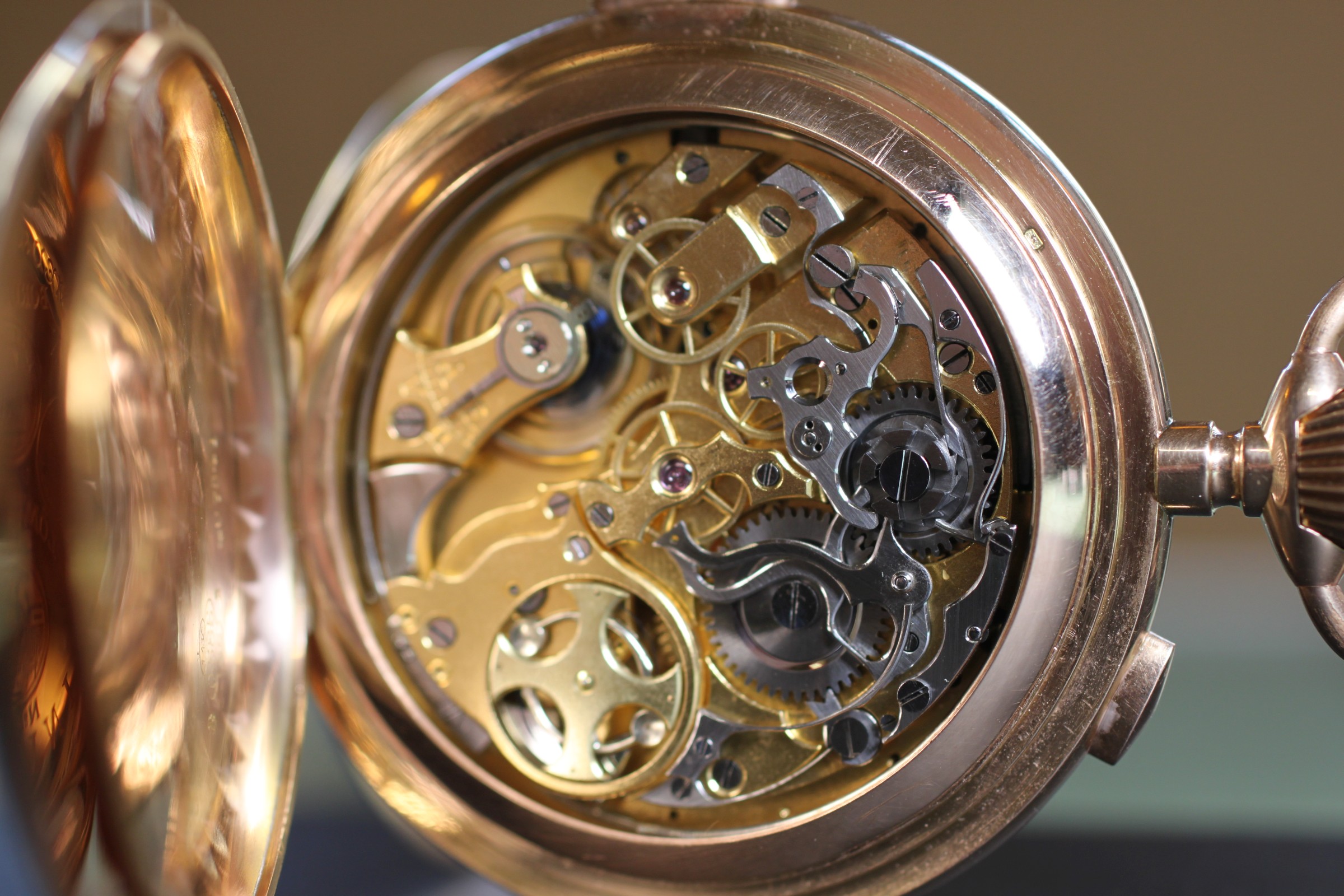
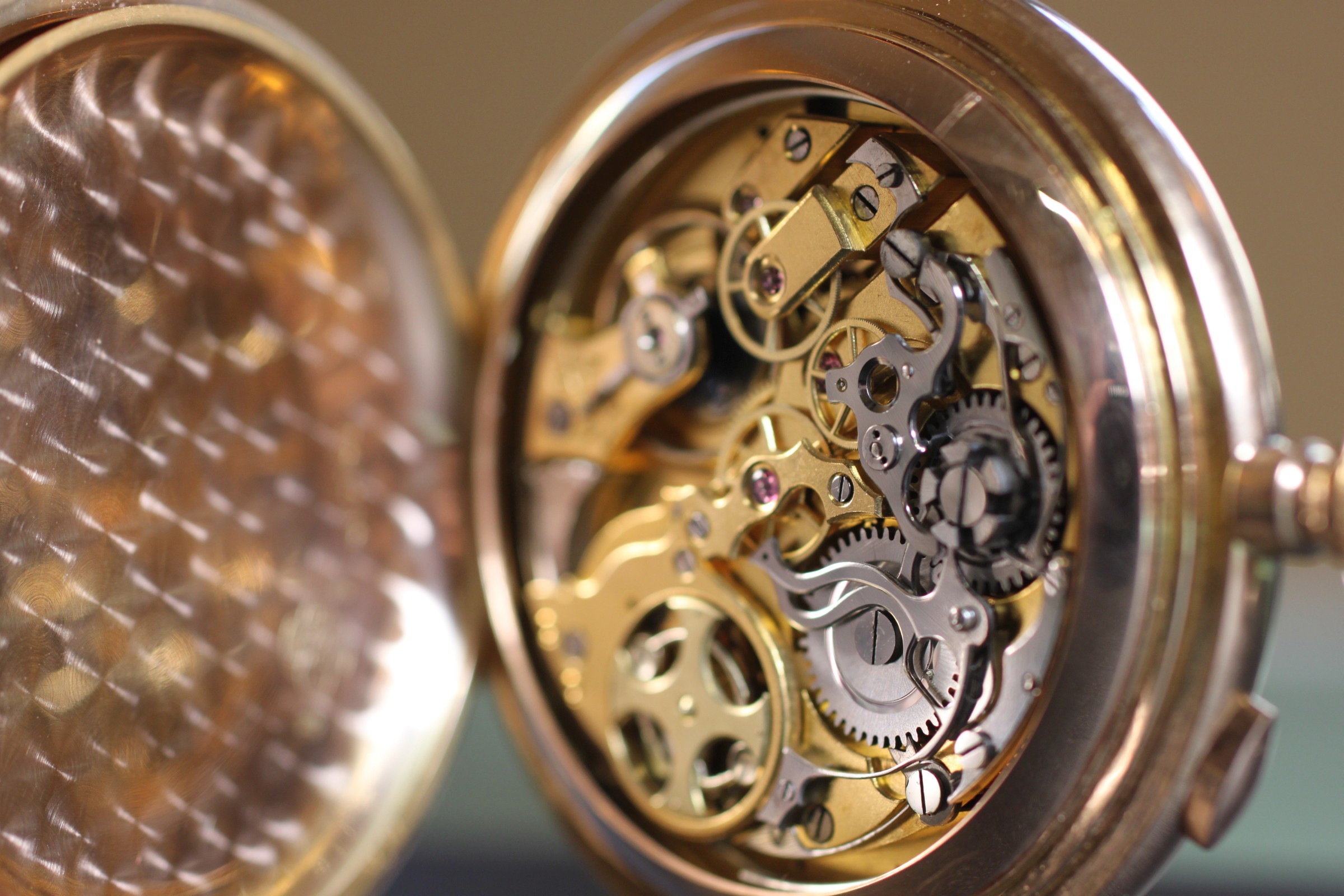
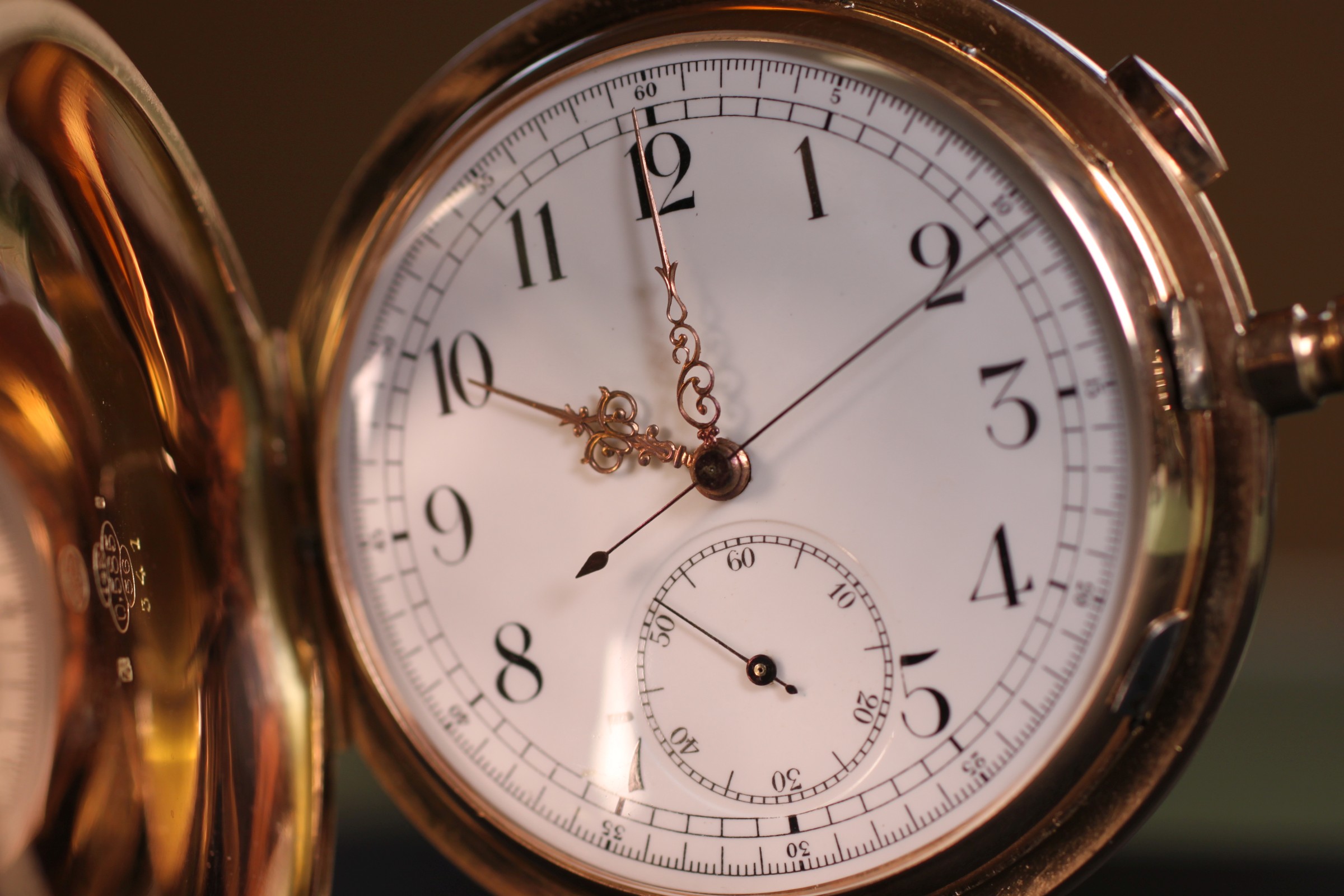
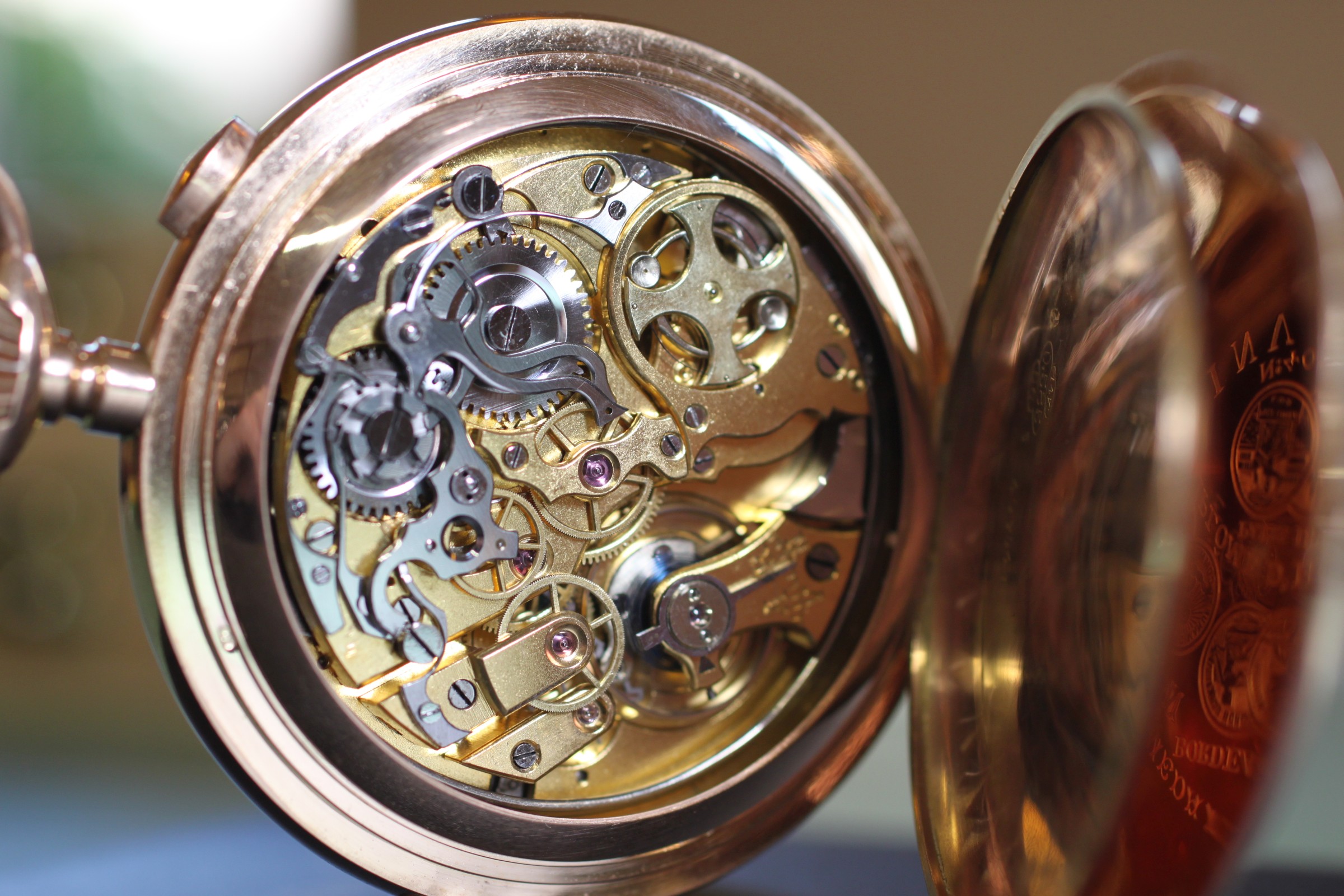
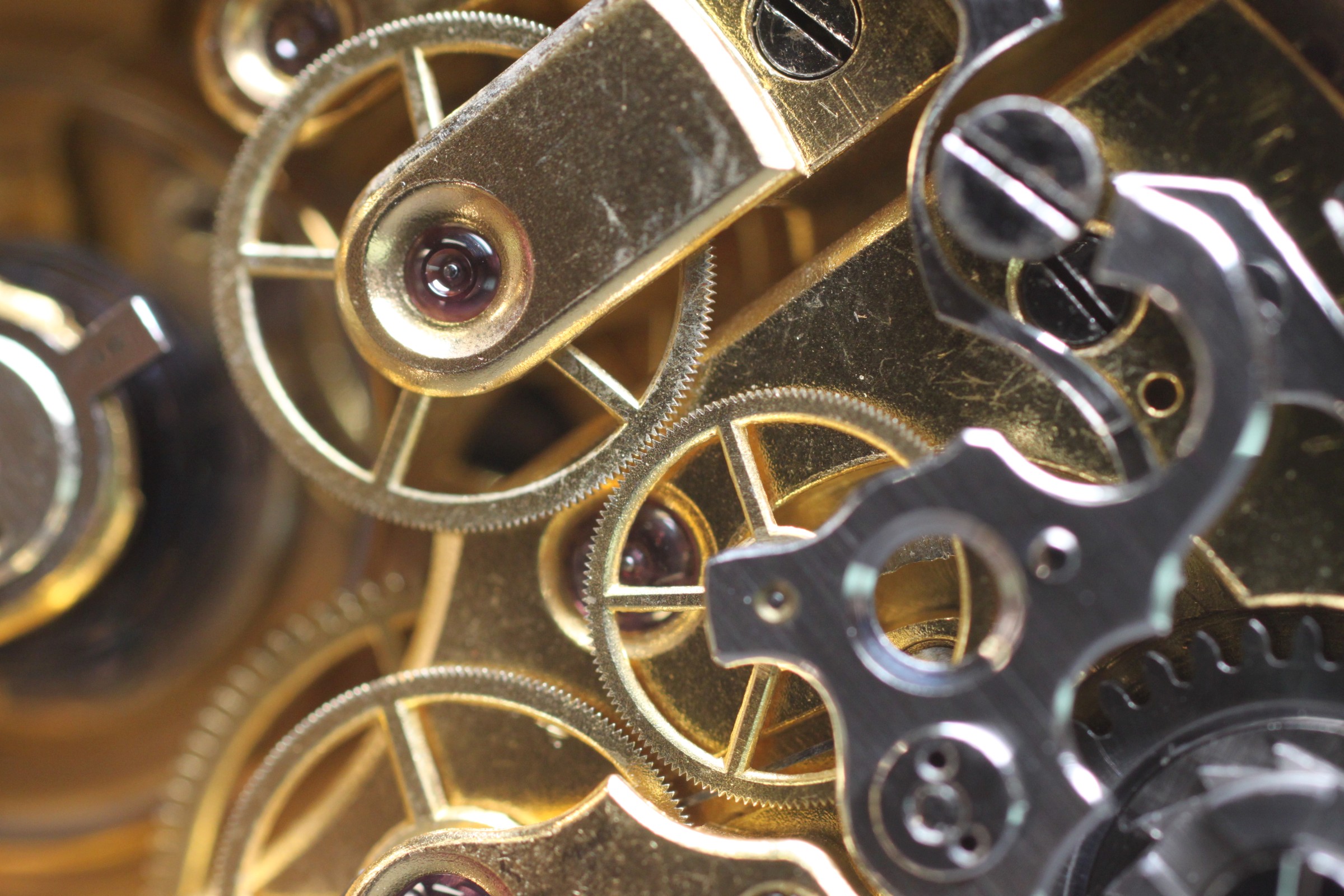
The chronograph wheels have very fine teeth, shown here in detail. The middle wheel sits on a rocking lever and is coupled to or uncoupled from the lower wheel, the central chronograph runner, when the chronograph is started or stopped.
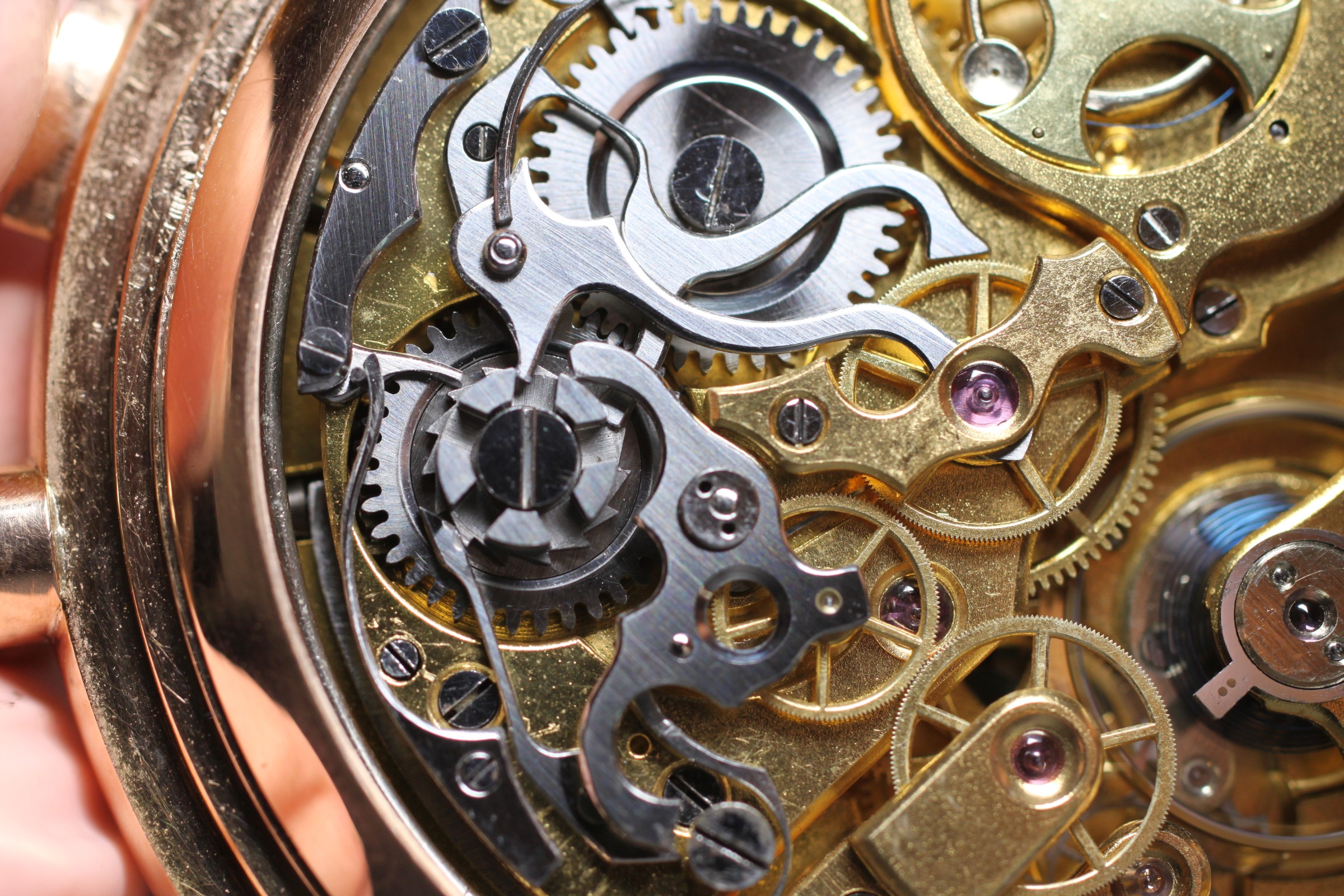
The chronograph levers are controlled by the central column wheel. The column wheel itself advances one tooth whenever the start/stop pusher is operated. The columns either lift the chronograph levers or allow them to fall again, triggering the chronograph’s various functions.
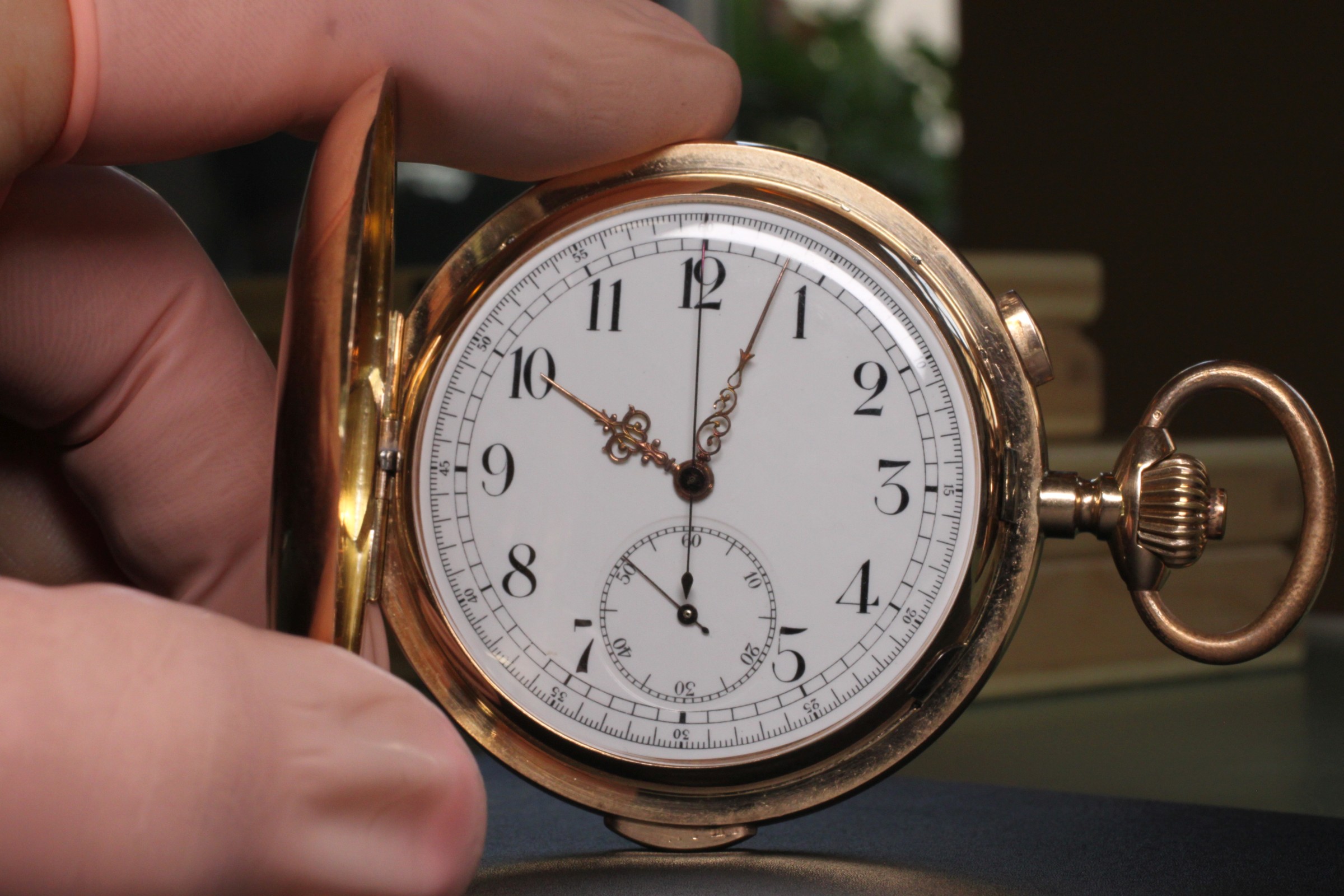
By successfully restoring this minute-repeating pocket watch, we have not only brought a masterpiece of watchmaking back to life but also preserved a piece of history. The precise mechanics and unmistakable sound of this complication remind us of the outstanding craftsmanship in each individual watch, and how valuable its preservation is for future generations.